MemoHoney Official Website › Disclaimer
DisclaimersMemoHoney Disclaimer
MemoHoney is a dietary supplement, not a medicine. Its statements have not been evaluated by the Food and Drug Administration, and it is not intended to diagnose, treat, cure or prevent any disease. Results vary from person to person, and this website is a retailer, not the manufacturer.
Below: the FDA statement, the medical and results notes, and how reviews, research, seals and prices are used on these pages.
The FDA statement on MemoHoney
Every page on this website carries the same statement in its footer. Here it is in full, with what it means.
These statements have not been evaluated by the Food and Drug Administration. This product is not intended to diagnose, treat, cure or prevent any disease.
What it means
Supplements are not approved by the FDA before they are sold. The company that makes a supplement is responsible for its safety and for its label being accurate, as the FDA’s own questions and answers explain.
What the label claims
The MemoHoney label claims Advanced Memory Support, with Focus, Clarity and Energy. Those are structure and function statements for a supplement, not claims to treat any condition.
Revised September 30, 2026. Earlier versions are replaced in place and the date above moves with each change.
Medical disclaimer for MemoHoney
Three notes on who the capsule is for, and where a dietary supplement stops.
Adults only
Healthy adults aged 18 and over. Not for anyone under 18, or anyone pregnant or nursing.
Medicines
Arginine and citrulline act on nitric oxide. If you take blood-pressure medicines, nitrates or erectile-dysfunction drugs, talk to your prescriber first.
Real memory change
Memory or thinking that is changing in a way that worries you is a reason to be assessed by a doctor, not a reason to start a supplement.
The label’s caution, in full
The caution says not to exceed the recommended dose; it asks pregnant or nursing mothers, children under 18 and anyone with a known medical condition to consult a physician before this or any dietary supplement; it says to keep the bottle out of children’s reach and not to use it if the safety seal is damaged or missing.
The pages on this website describe a supplement from its label and from published research. They are general information, not medical advice, and they do not replace advice from someone who knows your health. NCCIH’s advice on using supplements wisely is a good place to start.
MemoHoney and your doctor: when to book the visit first
MemoHoney is a dietary supplement. It does not treat memory loss, dementia or any diagnosed condition of thinking, and it is no substitute for an assessment.
- Memory loss that is new or getting worse. Forgetting that is changing, or that family and friends have started to notice, is worth a doctor’s visit. The National Institute on Aging lists treatable causes, including medicine side effects and low vitamin B12.
- Sudden confusion or sudden change. Confusion, trouble speaking or understanding, a drooping face, weakness on one side or a sudden loss of vision can mean a stroke. Call 911 at once (CDC: stroke signs and symptoms).
- Screening for dementia. A primary care doctor can run a short memory and thinking test and order checks for other causes; the NIA explains how that assessment works. MedlinePlus on dementia covers what comes after.
- Medicines that affect memory. MedlinePlus lists alcohol, some prescription medicines and the overuse of sedating drugs such as barbiturates, opioids and hypnotics among the causes of memory loss. Take your medicine list, and this bottle, to the appointment.
- The label’s own groups. Pregnancy, nursing, anyone under 18 and anyone with a known medical condition: the caution asks each to consult a physician first. Blood-pressure medicines, nitrates and erectile-dysfunction drugs are worth raising too, because arginine and citrulline act on nitric oxide.
- Niacin. One capsule adds 7.5 mg NE of niacin. The adult upper limit from supplements is 35 mg a day (NIH Office of Dietary Supplements); if you already take a B-complex or prescribed niacin, count it in.
Despite the name, the MemoHoney label lists no honey and no sugar, so the cautions that come with honey products do not apply to it. It is still an adult product: never give it to infants or children. Problems after taking any supplement can be reported to the FDA through MedWatch.
Forgetting that is new, getting worse or worrying the people around you deserves a doctor’s appointment before it gets a supplement.
Results with MemoHoney vary
Buyers here most often describe 3–6 weeks. Some notice sooner, some later and some not at all.
- Days 1–14
The routine, not the result
One capsule, 8 oz of water, 20 to 30 minutes before a meal. The reviews on this desk describe little in the first fortnight, and the complaint most often written is wanting more in week one.
- Weeks 3–6
Where most buyers here put the first change
The desk's review block gives 3 to 6 weeks as the usual wait. Keep the routine fixed so a change can be read at all: same time, same water, same meal.
- Day 30
The first bottle ends, and the seller's condition is met
The seller asks for at least 30 days of use before a claim. A two-bottle pack is half used.
- Day 60
The money-back window closes
Sixty days from the date of purchase, not from delivery. Decide before then; the claim is a phone call with the order ID.
The timeline above is drawn from what buyers on this desk describe, and from the seller’s terms. It is a guide to planning a fair trial, not a forecast of your result. Food, sleep and activity still matter, and MedlinePlus lists many everyday reasons memory varies.
How MemoHoney reviews, research and seals are used here
Four kinds of information on these pages, and the limits of each.
Reviews and order counts
The score of 4.7, the 1,001 written reviews and the 6,540 orders are this desk’s summary figures. They are not verified transcripts, not typical results and not evidence, and they never appear in structured data.
Research references
Studies are cited to show what an ingredient has been tested for and at what amount. The trials used gram doses of the amino acids, and no trial has tested this capsule; a citation here never means the capsule inherits a result.
Seals and marks
The ten marks in the seller’s artwork are statements about a factory process, an origin or an ingredient list; the bottle label itself prints only its origin line. The testing-and-quality page says what each one covers.
Prices
Prices were read off the seller’s page on 1 October 2026. The checkout shows the current price; struck figures are the seller’s comparison prices.
Images and artwork on the MemoHoney website
Pictures sell; labels inform. Here is how to read each kind of image on these pages.
Three kinds of image appear on these pages. The bottle and pack photographs show the product as it is sold. The label images, the wrap and the Supplement Facts panel, are the reference copy every amount on this website is checked against.
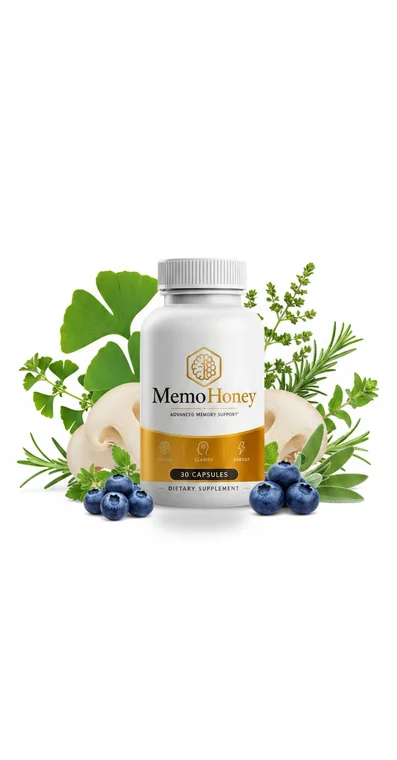
The styled scenes are the seller’s advertising artwork. They show the routine the capsule is sold for, and anything placed around the bottle, from ginkgo leaves to berries, is set dressing rather than a list of contents.
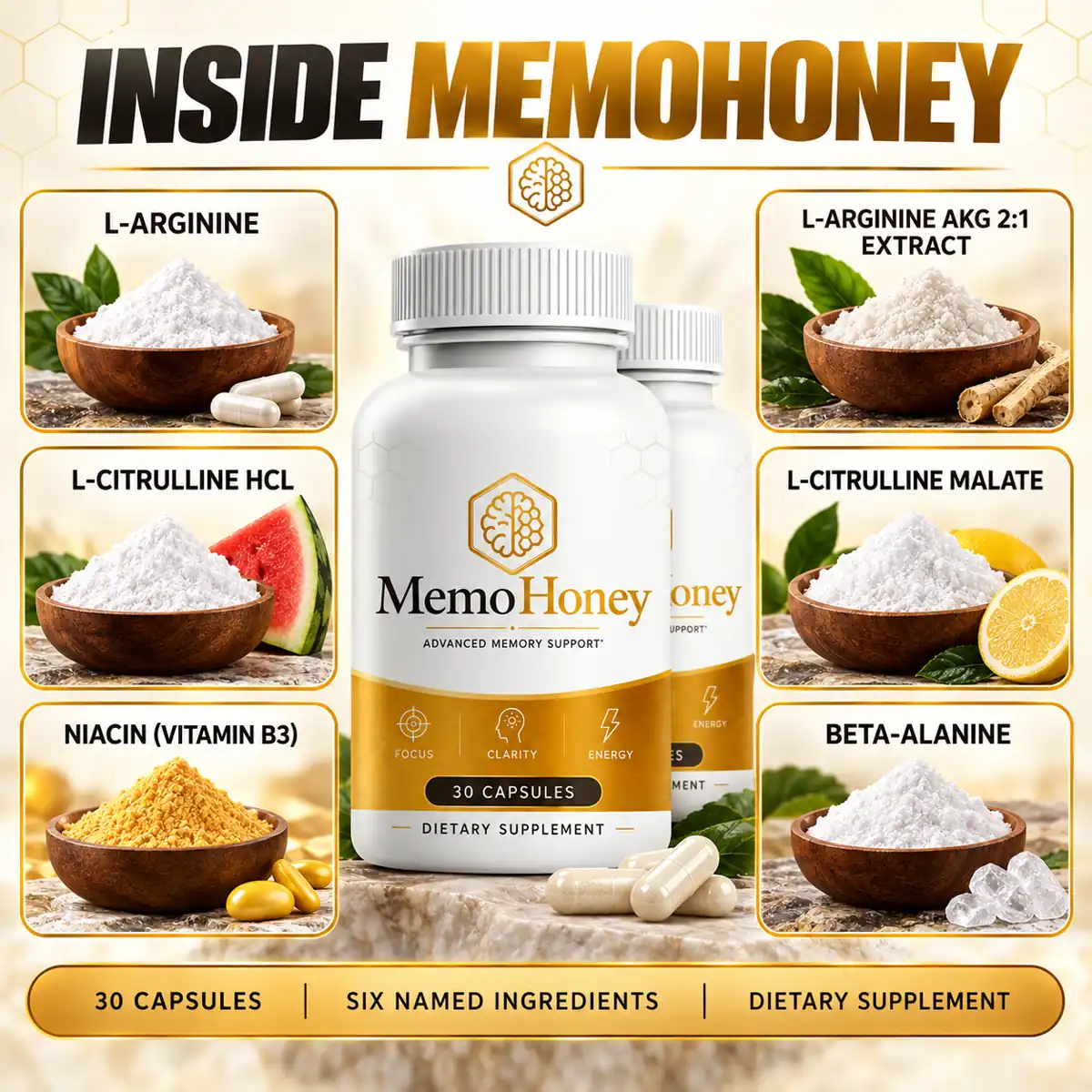
Where an artwork and the panel differ, the panel wins. The artwork shown here names six ingredients; the printed panel carries seven rows, adding calcium at 18 mg as calcium carbonate. The Supplement Facts page sets out all seven.
- What is in a capsule: the Supplement Facts panel
- How to take it and who should not: the label wrap
- What arrives in the box: the pack photographs
- The mood of the routine: the styled scenes, and nothing more
Links, earnings and the MemoHoney guarantee
Three things on these pages carry an interest or an outside source. Each is stated plainly.
Sponsored order links
Every order button opens the seller’s checkout through this website’s order link. Gomemohoney earns when a pack is sold that way, the links are marked sponsored in the page code, and the price you pay is the one the checkout shows.
Links to research
Citations point to PubMed, the NIH, the FDA and MedlinePlus so a statement can be checked at its source. A link is a reference for the reader, never an endorsement of MemoHoney by the body that published it.
A purchase policy
The 60-day money-back guarantee lets you try the routine and get your money back through order support. It is a purchase policy, not a promise about any health outcome. The refund policy sets out the terms.
A figure that does not match your label, a broken link or a claim that reads too strongly: tell the website desk through the inbox in the footer. The page is corrected in place and its review date moves forward.
The retailer role behind MemoHoney on this website
Gomemohoney sells MemoHoney and writes about it. The order links are marked as sponsored in the page code.
MemoHoney disclaimer questions
Is MemoHoney a medicine?
No. It is a dietary supplement. It is not intended to diagnose, treat, cure or prevent any disease, and the FDA does not approve supplements before they are sold.
Will it work for me?
Individual results vary. Buyers on this desk most often describe 3–6 weeks before noticing a change, and some notice nothing. The 60-day window exists for that reason.
Are the reviews independent?
No. They are this desk’s own order records and review summaries, shown as page copy and never as a search-engine rating.
Does citing the NIH or the FDA mean they endorse MemoHoney?
No. Those links point to public guidance and research records so a reader can check a statement at its source. No public body has reviewed or endorsed this capsule.
Are the herbs and berries in the product scenes ingredients?
No. The ginkgo leaves, rosemary, mushrooms and berries around the bottle are styling. The seven rows of the Supplement Facts panel are the complete list of what each capsule declares.
Who publishes this MemoHoney website?
The public sources this page relies on.
- U.S. Food and Drug Administration: Questions and Answers on Dietary Supplements, guidance read online. https://www.fda.gov/food/information-consumers-using-dietary-supplements/questions-and-answers-dietary-supplements
- National Center for Complementary and Integrative Health, National Institutes of Health: Using Dietary Supplements Wisely, guidance read online. https://www.nccih.nih.gov/health/using-dietary-supplements-wisely
- MedlinePlus topic page Memory, from the National Library of Medicine at NIH in Bethesda, read online. https://medlineplus.gov/memory.html
- Office of Dietary Supplements, National Institutes of Health: Dietary Supplements: What You Need to Know, guidance read online. https://ods.od.nih.gov/factsheets/WYNTK-Consumer/