MemoHoney Official Website › Testing & Quality
Seals and standardsMemoHoney Testing and Quality
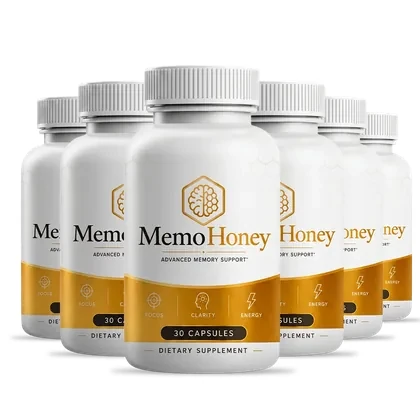
MemoHoney is made in the USA with globally sourced ingredients. The seller presents it with ten marks, from Good Manufacturing Practice to vegetarian; they are the seller’s artwork, and the bottle label prints only its origin line. Each mark is a statement about a factory process, a source or an ingredient list, readable against the seven-row panel.
Below: every seal and what it covers, the federal standard behind GMP, what FDA registration means, the lot reference, and the checks you can make yourself.
The ten MemoHoney seals and what each one covers
Every mark in the seller’s product artwork, with a plain line on what it is a statement about. None of the ten is printed on the bottle label, so a bottle check looks at the safety seal under the cap, the panel and the lot instead.
What Good Manufacturing Practice means for a MemoHoney capsule
The most important of the seller’s marks is also the least glamorous one.
Good Manufacturing Practice is the federal standard every dietary supplement factory in the United States works under, set out in 21 CFR part 111. It asks a manufacturer to write specifications for identity, purity, strength and composition, to keep a record of every batch, and to investigate complaints.
The FDA’s questions and answers on supplements describe the division of labour: the agency sets and inspects the manufacturing rules, and the company that makes the product is responsible for it being safe and labelled accurately.
The GMP seal is therefore a statement about the factory’s process. It is the reason a lot number means something: a batch record exists behind it.
Specifications
Written limits for identity, purity, strength and composition, set before a batch is made.
Batch records
A record of every production run, which is what a lot number on a bottle base points back to.
Complaint handling
A duty to review and investigate complaints about a product, and to keep the record.
FDA registration and MemoHoney: what the strip is saying
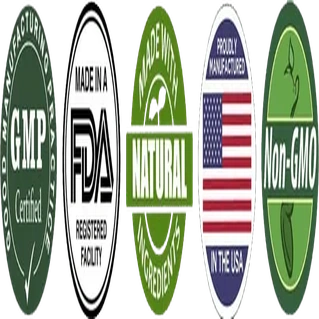
The five-mark strip uses the letters FDA. Here is exactly what they refer to.
A registered facility
Facilities that manufacture food and supplements for the US market register with the FDA. Registration puts the factory on a list the agency can inspect. It is true of the facility, and it is a real obligation.
An approval, which no supplement has
The FDA does not approve dietary supplements before they are sold, and MemoHoney is a dietary supplement. That is why every page on this website carries the FDA statement: these claims have not been evaluated by the agency.
GMP certified, FDA-registered facility, natural, USA and non-GMO are five different statements printed on one roundel. Two are about the factory, one about the country, one about sourcing and one is a marketing word.
MemoHoney’s free-from and origin claims, checked against the panel
Seven of the ten marks make a claim a reader can hold against the label. This is how each one reads.
| The seller’s mark | What the label shows | Verdict |
|---|---|---|
| Vegetarian | Hypromellose (vegetable) capsule; vegetable stearate | Consistent with the panel |
| Dairy free | Nothing milk-derived on the panel or the other ingredients | Consistent with the panel |
| Naturally gluten free | Amino acids, niacin and calcium carbonate carry no gluten | Consistent with the panel |
| Made in the USA | “Manufactured in the USA with globally sourced ingredients.” | Matches the label line |
| GMO free | A sourcing claim about the raw materials | Cannot be read off a label |
| 100% natural ingredients | Every compound occurs in food; each is manufactured for a capsule | An unregulated word |
| Doctor formulated | No formulator is named on the label or the seller’s page | A marketing line until someone is named |
The panel and other-ingredients line are the reference. Three free-from marks agree with it outright; the origin mark matches the label line.
The MemoHoney lot and certificate references
Two references identify the stock this desk ships.
Lot MEM-26/GO-8806
The lot this desk’s stock is filed under. The lot printed on your bottle’s base ties it to a batch record at the factory.
Certificate reference MEM-8806-26-GO
This desk’s filing reference for the batch paperwork. Lot and certificate references are filing labels for this desk's stock, not laboratory proof.
What independent testing of MemoHoney would add
Process marks and product testing are different things. Here is what the second kind covers.
Label accuracy
An outside laboratory measures each row and checks it against the printed amount, batch by batch.
Contaminants
Heavy metals and microbes are tested against published limits, rather than left to the factory’s own records.
A named programme
A verification mark names the organisation that did the testing, so a buyer can look the product up.
The seller’s ten marks are process, origin and free-from statements. None of them is an independent product-testing mark, and this desk holds no laboratory report to publish. That is the one limit worth knowing.
Three MemoHoney quality checks you can make yourself
No laboratory needed: the three checks that matter most are on the bottle.
- 1
Check the seal
Intact under the cap before the first capsule. The label asks you not to use the bottle otherwise.
- 2
Check the panel
Seven rows with calcium among them, one capsule a serving, thirty servings.
- 3
Check the base
A lot number and, where shown, a best-before date. Order support at +1 (302) 200-3480 can match it to your order.
MemoHoney testing and quality questions
Does the FDA approve MemoHoney?
No. The FDA does not approve any supplement before it is sold; the manufacturer is responsible for safety and for the label being accurate. The seller’s five-mark strip says the capsule is made in an FDA-registered facility, which is a registration, not an approval.
Where is MemoHoney made?
The label reads: “Manufactured in the USA with globally sourced ingredients.” The distributor named on the label is Instituto Experience, Ogden, Utah.
Is MemoHoney vegetarian?
The label points that way: the shell is hypromellose, a vegetable capsule, and the other ingredients are vegetable stearate and silicon dioxide. The seller’s artwork adds a vegetarian mark to match.
Does MemoHoney contain gluten or dairy?
Nothing on the seven-row panel or the other-ingredients line comes from milk or wheat, and the seller’s artwork marks it dairy free and naturally gluten free. The bottle label prints no allergen statement of its own.
What does GMP mean on the seal?
Good Manufacturing Practice: the federal manufacturing standard for supplements, covering specifications, batch records, cleanliness and complaint handling at the factory.
What is the lot number on a MemoHoney bottle for?
It ties the bottle to a batch record at the factory, the record Good Manufacturing Practice requires for every production run. This desk files its stock under lot MEM-26/GO-8806, and order support on +1 (302) 200-3480 can match the lot on your base to your order.
Is the certificate reference a laboratory report?
No. Lot and certificate references are filing labels for this desk's stock, not laboratory proof. It is the reference this desk files the batch paperwork under, and it is quoted so that a question about a bottle can be traced to the right stock.
How should a MemoHoney bottle be stored?
The label: “Store in a cool, dry place away from heat and light.” Keep the lid closed between capsules and the bottle out of a steamy bathroom; heat and damp are what shorten a capsule’s life.
Who publishes this MemoHoney website?
Federal and NIH sources on who is responsible for a supplement’s quality and label.
- Questions and Answers on Dietary Supplements. U.S. Food and Drug Administration. https://www.fda.gov/food/information-consumers-using-dietary-supplements/questions-and-answers-dietary-supplements
- Dietary Supplements: What You Need to Know. Office of Dietary Supplements, National Institutes of Health. https://ods.od.nih.gov/factsheets/WYNTK-Consumer/
- Using Dietary Supplements Wisely. National Center for Complementary and Integrative Health, National Institutes of Health. https://www.nccih.nih.gov/health/using-dietary-supplements-wisely