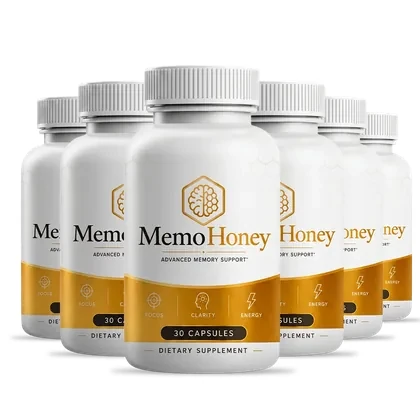
MemoHoney Official Website › Supplement Facts
The label, printedMemoHoney Supplement Facts, Row by Row
The MemoHoney Supplement Facts panel gives one capsule as the serving and 30 servings a bottle, then seven rows: niacin 7.5 mg NE (47% DV), calcium 18 mg (1.5% DV), L-arginine 200 mg, L-arginine AKG 200 mg, L-citrulline HCl 100 mg, L-citrulline malate 100 mg and beta alanine 40 mg.
Other ingredients: a hypromellose capsule, vegetable stearate and silicon dioxide.
The panel as printed and as text, how to read each line, the full label laid flat, and every amount beside the dose the research used.
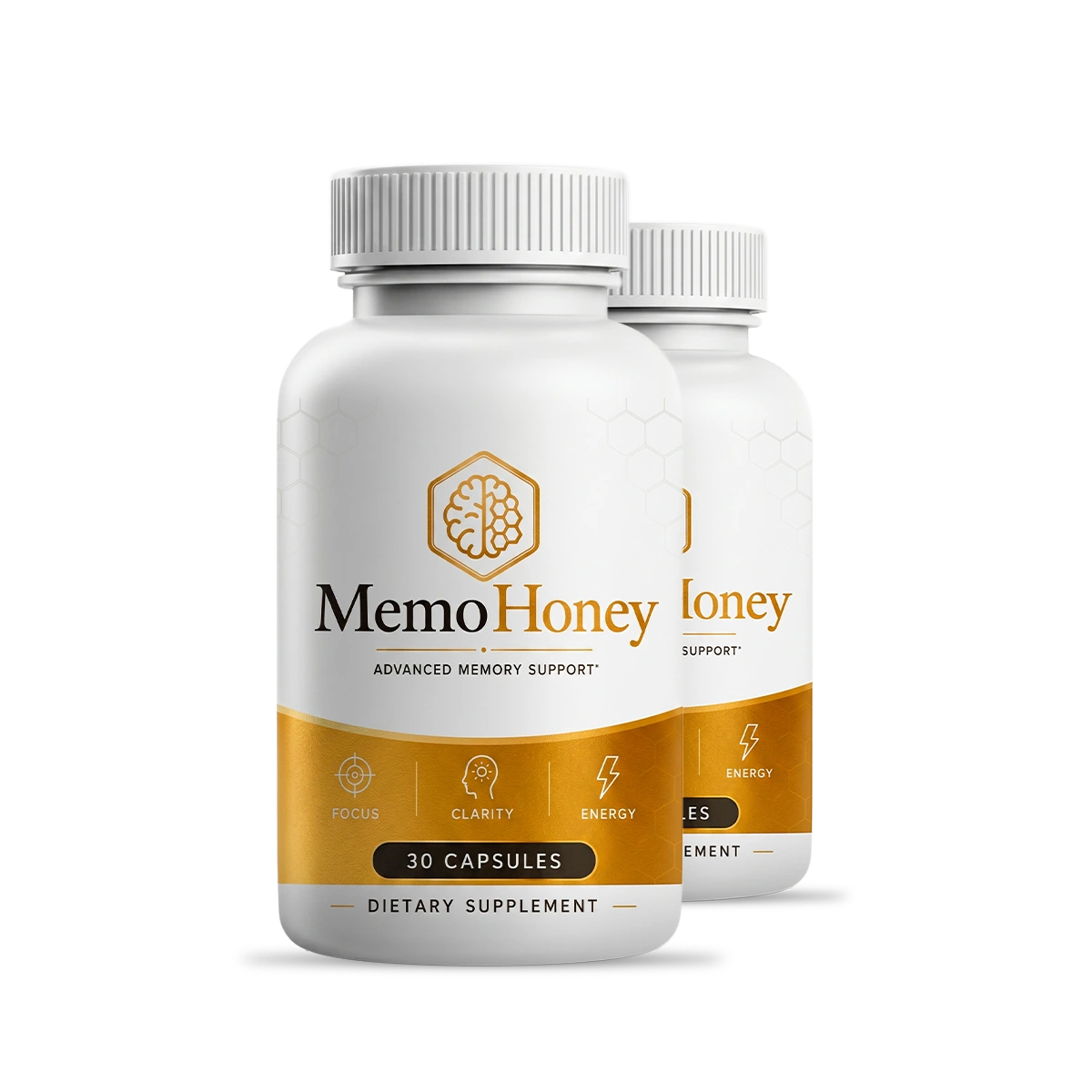
The MemoHoney panel, as printed and as text
Photograph on one side, text on the other, so every figure can be checked against the bottle and copied without squinting.
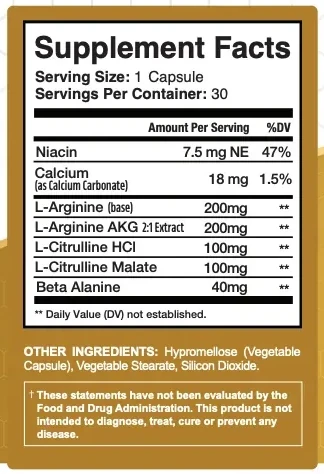
Supplement Facts
Serving Size: 1 Capsule
Servings Per Container: 30
| Per capsule | Amount | % Daily Value |
|---|---|---|
| Niacin | 7.5 mg NE | 47% |
| Calcium (as calcium carbonate) | 18 mg | 1.5% |
| L-Arginine (base) | 200 mg | not set |
| L-Arginine AKG (2:1 extract) | 200 mg | not set |
| L-Citrulline HCl | 100 mg | not set |
| L-Citrulline Malate | 100 mg | not set |
| Beta Alanine | 40 mg | not set |
"Not set": the label marks these five rows Daily Value not established.
Other ingredients: Hypromellose (vegetable capsule), vegetable stearate, silicon dioxide.
The text version copies the label row for row, in the label's order: the two nutrients first, then the five amino acids. The only change is the label's double-asterisk mark, written out here as 'not set' because it means the Daily Value is not established.
How to read each line of the MemoHoney panel
Four lines of heading, then the rows. Each part of a Supplement Facts panel has one job.
- 1
Serving size: 1 capsule
Every amount below it is for one capsule. The label's directions make one capsule the daily serving, so the rows are also the daily amounts.
- 2
Servings per container: 30
Thirty capsules, thirty days. A two-bottle pack is sixty days, three bottles ninety and six bottles one hundred and eighty.
- 3
Amount per serving
Milligrams for everything except niacin, which is given in niacin equivalents (NE). Each row is its own amount; nothing is hidden in a blend total.
- 4
% Daily Value
Set against adult Daily Values: 16 mg NE for niacin, so 7.5 mg NE is 47%. The label prints 1.5% for calcium; the NIH calcium fact sheet gives 1,300 mg, of which 18 mg is about 1.4%. Amino acids have no Daily Value, hence the mark.
Niacin equivalents let niacin from different sources be counted together: 1 mg NE is 1 mg of niacin or 60 mg of tryptophan, the amino acid the body can convert. The unit comes from the Institute of Medicine reference intakes, which also set the 35 mg adult upper intake for supplemental niacin. The NIH niacin fact sheet gives the same figures in plain language.
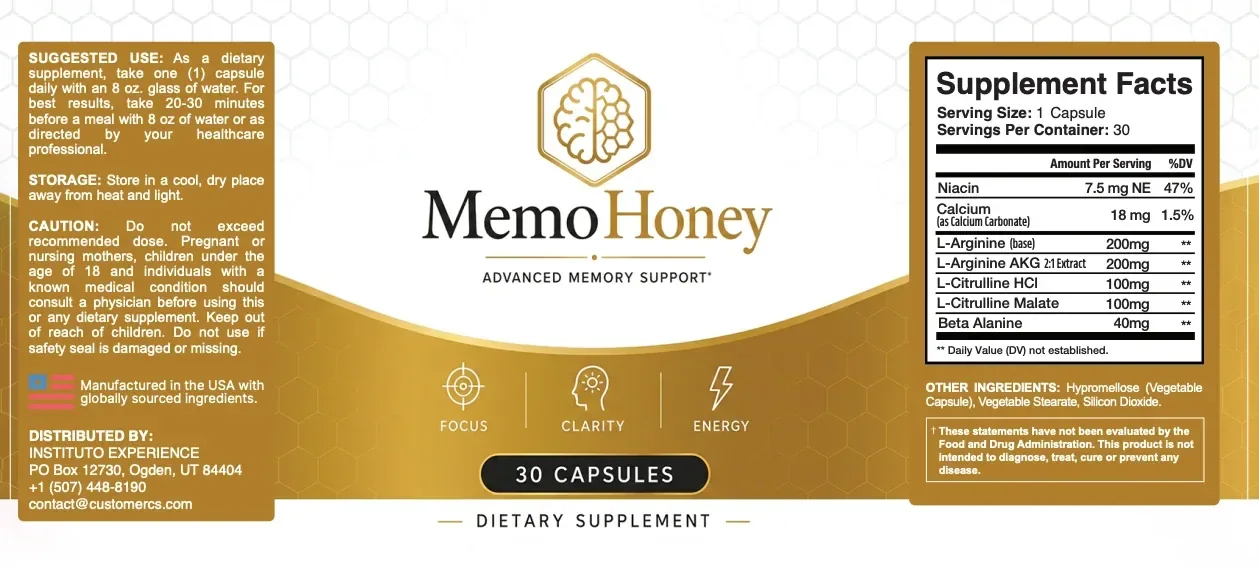
The full MemoHoney label, laid flat
The panel is one part of a label that also carries directions, storage, a caution and an origin line.
| Label panel | What it says |
|---|---|
| Front | MemoHoney · Advanced Memory Support · Focus · Clarity · Energy · 30 Capsules · Dietary Supplement |
| Directions | As a dietary supplement, take one (1) capsule daily with an 8 oz. glass of water. For best results, take 20-30 minutes before a meal with 8 oz of water or as directed by your healthcare professional. |
| Storage | Store in a cool, dry place away from heat and light. |
| Caution | Do not exceed the recommended dose. Pregnant or nursing mothers, under-18s and anyone with a known medical condition are asked to check first. Keep out of reach of children; do not use if the safety seal is damaged or missing. Full wording and what it means. |
| Origin | Manufactured in the USA with globally sourced ingredients. |
| Distributor | Instituto Experience, Ogden, Utah |
Directions, storage and origin are the label's own words. Tracking and refunds go through this desk, not the distributor named on the label.
What the MemoHoney panel adds up to
A printed panel makes the sums possible. These are the totals worth knowing.
The declared rows add up to 665.5 mg a capsule. The shell, the stearate and the silica make up the rest of what you swallow and carry no amount because they are not active ingredients. The two arginine rows are the largest share at 400 mg; beta alanine at 40 mg and niacin at 7.5 mg are the smallest ingredient rows, and calcium at 18 mg sits between them.
The row weights are the weights of the forms, not of amino acid alone. Arginine AKG 2:1 is two arginines bound to one alpha-ketoglutarate, the hydrochloride carries hydrochloric acid and the malate carries malic acid. Take those partners out by molecular weight and the two arginine rows hold about 340 mg of arginine, the four nitric-oxide rows about 480 to 500 mg, and the five amino-acid rows about 520 to 540 mg of amino acid in all. The malate row makes it a range: the panel does not print its citrulline-to-malate ratio.
MemoHoney's printed amounts beside the research doses
The one place on this website where every printed amount meets the dose the published research gave. The research was dosed in grams.
| Panel row | Per capsule | What the research used | In round numbers |
|---|---|---|---|
| Niacin | 7.5 mg NE | Adult Daily Value 16 mg NE; adult upper intake 35 mg a day from supplements; the drug-dose trials used 2,000 mg. | about a fifth of the adult upper intake |
| Calcium | 18 mg | Adult Daily Value 1,300 mg. A glass of milk carries roughly 300 mg. | 1.5 per cent of the Daily Value |
| L-Arginine | 200 mg | 6.4 g a day for 30 days in the one cognition pilot; 3 to 24 g a day across the blood-vessel trials. | about one thirty-second of the cognition-pilot dose |
| L-Arginine AKG | 200 mg | 12 g a day, 4 g three times daily, in both controlled trials; a single 3 g dose changed nothing measurable. | one sixtieth of the trial dose |
| L-Citrulline HCl | 100 mg | 3 to 9 g a day across the blood-pressure trials; only the arms at 6 g or more moved anything. | one sixtieth of the 6 g threshold |
| L-Citrulline Malate | 100 mg | 3 g a day for six weeks in older women alongside exercise; 0.1 g per kg of body weight in the performance trials. | one thirtieth of the older-women dose |
| Beta Alanine | 40 mg | 2.4 g a day in the older-adult imaging trial; 4 to 6 g a day for at least four weeks in the sports position stand. | one sixtieth of the imaging-trial dose |
Research doses are the daily amounts the cited trials gave; each row links its source on the ingredients page. No trial has tested this capsule.
Where each research figure comes from
Arginine: the 6.4 g cognition pilot. Arginine AKG: the 12 g pharmacokinetic trial. Citrulline: the 3 to 9 g blood-pressure meta-analysis. Citrulline malate: the 3 g older-women pilot. Beta alanine: the 2.4 g imaging trial and the 4 to 6 g position stand. Niacin: the Daily Value and upper intake above.
What the gap means
Every amino-acid row is between a sixtieth and a thirtieth of the amount the research used, and no trial has tested this capsule or these amounts. A capsule of this size could not hold gram doses of five amino acids; that would take a scoop of powder. Niacin is the exception, sized to the Daily Value.
What it does not mean
It does not make the capsule unsafe or the panel misleading: the amounts are printed for anyone to compare. It means the capsule cannot borrow a trial's result, and that the fair test is your own sixty days.
Seven rows on the MemoHoney panel, six names in the advertising
The advertised list and the panel line up name for name, with one row extra on the panel.
| As advertised | As printed on the panel | Per capsule |
|---|---|---|
| L-Arginine | L-Arginine (base) | 200 mg |
| L-Arginine AKG 2:1 Extract | L-Arginine AKG (2:1 extract) | 200 mg |
| L-Citrulline HCL | L-Citrulline HCl | 100 mg |
| L-Citrulline Malate | L-Citrulline Malate | 100 mg |
| Niacin (Vitamin B3) | Niacin | 7.5 mg NE |
| Beta-Alanine | Beta Alanine | 40 mg |
| Not on the advertised list | Calcium (as calcium carbonate) | 18 mg |
Advertised names are spelled as the seller prints them; panel rows as the label prints them.
The advertising and the seller's 'Inside MemoHoney' graphic name six ingredients. The panel prints the same six plus calcium, 18 mg. When a list and a panel differ, go by the panel: it is the part of the label the regulations govern.
Checking the MemoHoney panel on your own bottle
The panel on the bottle in your hand is the authority. Four checks take a minute.
- 1
Find the panel
It runs down the side of the label, to the right of the front. The heading reads Supplement Facts in heavy type.
- 2
Match the serving lines
Serving size 1 capsule, servings per container 30. A different count means a different product or pack.
- 3
Read the seven rows
Niacin 7.5 mg NE, calcium 18 mg, then the five amino acids at 200, 200, 100, 100 and 40 mg, in that order.
- 4
Check the seal and the base
The safety seal should be intact. This desk's stock is filed under lot MEM-26/GO-8806; verify a bottle covers the rest.
MemoHoney Supplement Facts questions
What is on the MemoHoney Supplement Facts panel?
Serving size 1 capsule, 30 servings, and seven rows: niacin 7.5 mg NE (47% DV), calcium 18 mg as calcium carbonate (1.5% DV), L-arginine 200 mg, L-arginine AKG 2:1 extract 200 mg, L-citrulline HCl 100 mg, L-citrulline malate 100 mg and beta alanine 40 mg.
What does the double asterisk on the MemoHoney panel mean?
Daily Value not established. It marks the five amino-acid rows, which have no Daily Value. This website writes it out rather than printing the symbol.
How many milligrams are in one MemoHoney capsule?
665.5 mg of declared ingredients, 640 mg of them in the five amino-acid rows (about 520 to 540 mg of amino acid once the AKG, hydrochloride and malate carriers are counted out), plus the capsule shell, vegetable stearate and silicon dioxide.
Does MemoHoney use a proprietary blend?
No. Every row has its own printed amount.
How do MemoHoney amounts compare with clinical research?
The panel prints every amount, so each row can be set beside the daily dose its research used. The dosage table above does that row by row, with every study linked. No trial has tested the finished capsule.
Sources for the MemoHoney Supplement Facts page
The reference intakes behind the two percentages and the trials behind the dose table.
- Institute of Medicine (US) Standing Committee on the Scientific Evaluation of Dietary Reference Intakes. Niacin. In: Dietary Reference Intakes for Thiamin, Riboflavin, Niacin, Vitamin B6, Folate, Vitamin B12, Pantothenic Acid, Biotin, and Choline. Washington (DC): National Academies Press; 1998. Defines niacin equivalents (NE) and sets the adult tolerable upper intake at 35 mg/day from supplements, with flushing as the critical effect. NCBI Bookshelf NBK114304. https://www.ncbi.nlm.nih.gov/books/NBK114304/
- Niacin: Fact Sheet for Health Professionals. Office of Dietary Supplements, National Institutes of Health. https://ods.od.nih.gov/factsheets/Niacin-HealthProfessional/
- Calcium: Fact Sheet for Health Professionals. Office of Dietary Supplements, National Institutes of Health. https://ods.od.nih.gov/factsheets/Calcium-HealthProfessional/
- Teotia S, Rana AK, Gupta V. Comparison of the Safety and Efficacy of Oral L-arginine for the Treatment of Cognitive Impairment in Older Adults: A Prospective, Randomized, Placebo-Controlled Pilot Study. Cureus. 2026;18(7):e112987. Thirty-eight participants, oral L-arginine 6.4 g/day for 30 days. PMID 42621366. https://pubmed.ncbi.nlm.nih.gov/42621366/
- Campbell B, Roberts M, Kerksick C, et al. Pharmacokinetics, safety, and effects on exercise performance of L-arginine alpha-ketoglutarate in trained adult men. Nutrition. 2006;22(9):872-81. Four grams three times daily, 12 g/day for eight weeks. PMID 16928472. https://pubmed.ncbi.nlm.nih.gov/16928472/
- Barkhidarian B, Khorshidi M, Shab-Bidar S, et al. Effects of L-citrulline supplementation on blood pressure: A systematic review and meta-analysis. Avicenna J Phytomed. 2019;9(1):10-20. Doses ran 3 to 9 g/day, and only the arms at 6 g/day or more moved diastolic pressure. PMID 30788274. https://pubmed.ncbi.nlm.nih.gov/30788274/
- Ramos-Hernández R, Pascual-Fernández J, Alvarez-Pardo S, et al. Short-term citrulline malate supplementation enhances lower-limb function in physically active older women: A pilot randomized controlled trial. Clin Nutr ESPEN. 2026;74:103356. Twenty women aged 60-75, 3 g/day for six weeks alongside exercise. PMID 42162613. https://pubmed.ncbi.nlm.nih.gov/42162613/
- Ostfeld I, Zamir A, Ben-Zeev T, et al. beta-Alanine supplementation improves fractional anisotropy scores in the hippocampus and amygdala in 60-80-year-old men and women. Exp Gerontol. 2024;194:112513. Twenty participants at 2.4 g a day. PMID 38971131. https://pubmed.ncbi.nlm.nih.gov/38971131/
- Trexler ET, Smith-Ryan AE, Stout JR, et al. International society of sports nutrition position stand: Beta-Alanine. J Int Soc Sports Nutr. 2015;12:30. Four to six grams daily for at least four weeks, with paraesthesia the one reported side effect. PMID 26175657. https://pubmed.ncbi.nlm.nih.gov/26175657/