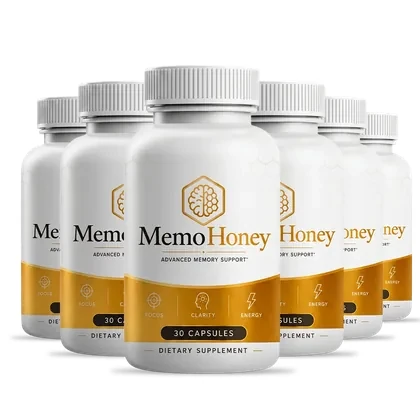
MemoHoney Official Website › How It Works
The mechanismHow Does MemoHoney Work?
MemoHoney works through three ordinary pathways in the body. Four arginine and citrulline rows, printed at 600 mg, feed nitric oxide, the signal that relaxes blood-vessel walls; 7.5 mg of niacin feeds NAD, the coenzyme cells use to turn food into energy; 40 mg of beta alanine is the building block of carnosine.
One capsule a day keeps that supply steady, and most buyers on this desk describe 3 to 6 weeks before they notice a change.
Each pathway below is standard physiology with a public source behind it, matched to the rows on the label that supply it.
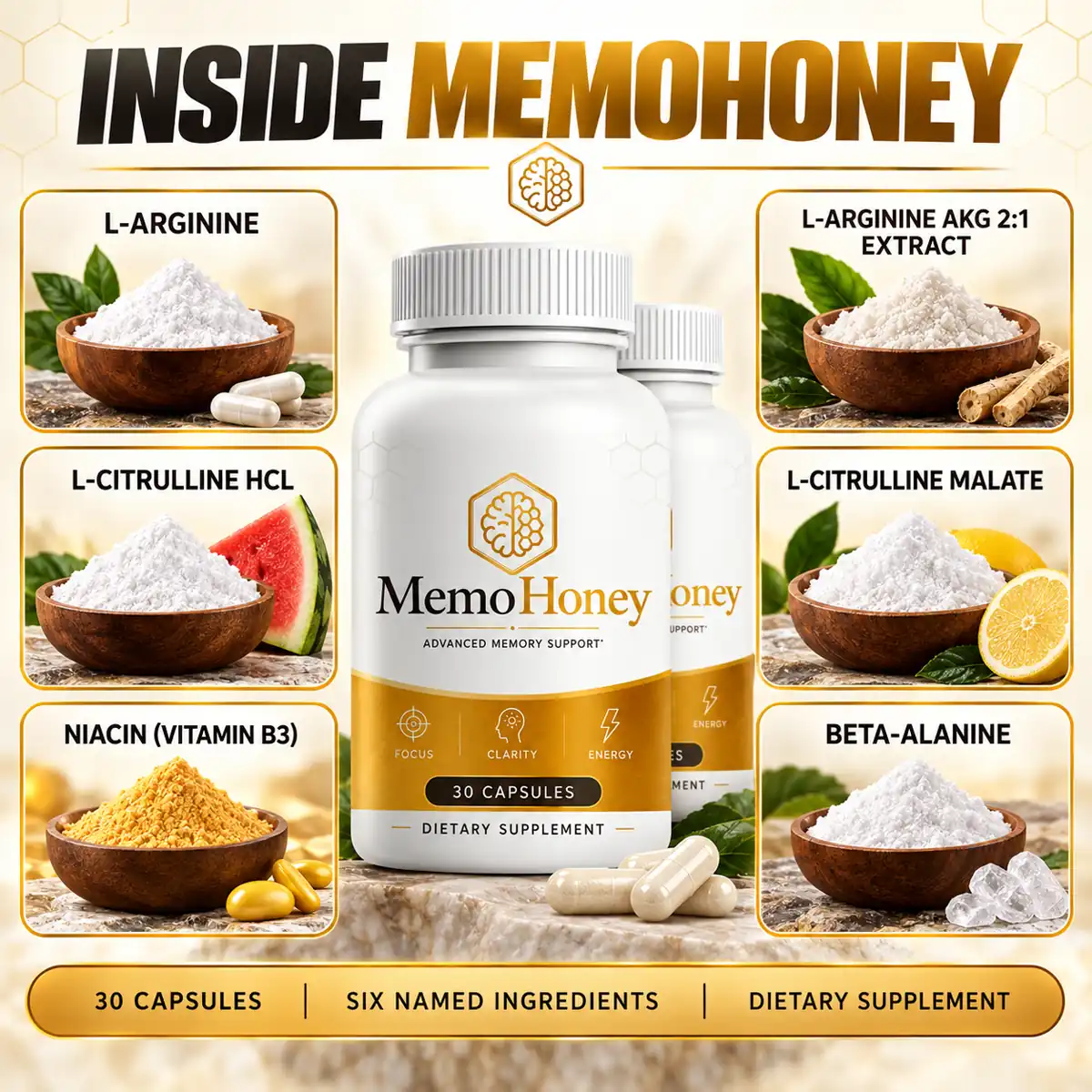
The three pathways behind MemoHoney, plus one mineral
Seven rows, three jobs. The cards sort the panel by the pathway each row supplies.
Nitric oxide: four rows, 600 mg
L-arginine 200 mg, arginine AKG 200 mg, citrulline HCl 100 mg and citrulline malate 100 mg. Arginine is the raw material for nitric oxide; citrulline is recycled back into arginine. This is the pathway the label's 'energy' and 'clarity' lines lean on most.
Cell energy: niacin, 7.5 mg NE
Niacin becomes NAD and NADP, the coenzymes cells use to release energy from food. The capsule supplies 47% of the adult Daily Value, the one nutrition-label amount in the formula.
Carnosine: beta alanine, 40 mg
Beta alanine is joined to histidine to make carnosine, a compound stored in muscle and in the brain. Its supply is what limits how much carnosine the body makes.
A mineral: calcium, 18 mg
Calcium carbonate, 1.5% of the Daily Value. It rounds out the panel rather than driving a pathway, and it is the one row the advertising leaves off.
How MemoHoney's arginine and citrulline rows feed nitric oxide
Four of the seven rows are two routes into one cycle. The steps follow a single molecule round it.
- 1
Arginine arrives
The capsule supplies arginine two ways: 200 mg as the free amino acid and 200 mg as arginine AKG, where part of the weight is the carrier.
- 2
An enzyme makes nitric oxide
Nitric oxide synthase, in the lining of blood vessels and in nerve cells, splits arginine into nitric oxide and citrulline.
- 3
Citrulline goes round again
The kidneys turn citrulline back into arginine. The capsule's 200 mg of citrulline enters the cycle here, after the step where swallowed arginine is lost.
- 4
Vessel walls relax
Nitric oxide tells the smooth muscle in artery walls to relax, which widens the vessel. A meta-analysis of arginine trials measured this as flow-mediated dilation in the arm.
| Panel row | Per capsule | Where it enters the cycle |
|---|---|---|
| L-Arginine (base) | 200 mg | Step 1, directly as the enzyme's raw material |
| L-Arginine AKG 2:1 | 200 mg | Step 1, once the carrier is split off |
| L-Citrulline HCl | 100 mg | Step 3, converted to arginine in the kidneys |
| L-Citrulline Malate | 100 mg | Step 3, the same route, with malic acid alongside |
Four rows, one cycle: 400 mg of arginine forms and 200 mg of citrulline forms as printed. With the AKG, hydrochloride and malate split off, that is about 340 mg entering as arginine and about 140 to 155 mg as citrulline.
Why MemoHoney pairs arginine with citrulline
Two amino acids that do the same job by different routes, which is the reason both are on the panel.
Arginine taken by mouth has a known weakness: a good share of it is broken down by enzymes in the gut and the liver before it reaches the circulation. Citrulline is not, and the kidneys convert it to arginine afterwards. The head-to-head pharmacokinetic trial gave healthy volunteers each compound and found that citrulline raised blood arginine further than arginine itself.
So the two are complementary rather than repetitive. Arginine is available at once; citrulline tops the pool up later in the day. Formulas built around nitric oxide almost always carry both for that reason, and MemoHoney carries each in two forms.
The same trial measured arginine rising and falling within hours of a dose. That is the practical reason the label asks for one capsule every day rather than an occasional one: the supply is steady only if the habit is.
Niacin in MemoHoney and the NAD that cells run on
The one B vitamin on the panel, at a nutrition-label amount, feeding the coenzyme behind energy metabolism.
From niacin to NAD
The body turns niacin into nicotinamide adenine dinucleotide, NAD, and its phosphate form NADP. The NIH niacin fact sheet describes NAD as a coenzyme for hundreds of enzymes, most of them in the reactions that release energy from food.
Why the brain cares
Nerve cells have high, constant energy demands and little stored fuel, so they depend on those energy reactions running without interruption. Niacin is one of the B vitamins that keep the machinery supplied, which is how it relates to the 'energy' line on the label.
Why 7.5 mg is the right kind of amount
7.5 mg NE is 47% of the adult Daily Value, the amount a nutrition label is built around. Diet supplies the rest. The large niacin doses in cholesterol trials were drug doses, grams a day, and they belong to a different conversation.
- 7.5 mg NE per capsule, and one capsule is the day's serving.
- 47% of the 16 mg NE Daily Value for adults.
- About a fifth of the 35 mg upper intake for supplemental niacin.
- The only row that is both a vitamin and a percentage of the day.
Beta alanine in MemoHoney and the carnosine it builds
The smallest amino-acid row, and the one that works on a reserve the body builds up over weeks.
What carnosine is
Carnosine is a small molecule of two amino acids, beta alanine and histidine. It is stored in skeletal muscle and in the brain, where it acts as a buffer. The sports-nutrition position stand explains that beta alanine, not histidine, is the part in short supply.
Why it builds over weeks
Carnosine stores rise slowly with a steady intake of beta alanine and fall slowly when it stops. That is why the research on beta alanine runs for weeks, and why a daily capsule matters more than any single one.
Where the brain research stands
An older-adult imaging trial looked at brain structure in 60 to 80-year-olds taking beta alanine, and a review of carnosine-type compounds looked at delayed recall. Both are early and small, and both used their own products and amounts.
How it fits the label
Carnosine's link to muscle and brain buffering is why beta alanine sits in a formula sold for focus and energy. It is the one row that works on a stored reserve rather than a same-day signal.
Why MemoHoney is a once-a-day capsule
Each pathway has its own clock, and one capsule a day is the schedule that fits all three.
- 1
Same-day signals
Arginine and citrulline rise and fall within hours. A capsule every morning keeps the nitric-oxide cycle supplied each day rather than on some days.
- 2
Slow reserves
Carnosine builds over weeks of steady beta-alanine intake, so a missed day matters less than a missed fortnight.
- 3
A daily nutrient
Niacin is a water-soluble vitamin and the body keeps only small stores of it, which is why its Daily Value is exactly that: an amount for each day.
One capsule with an 8 oz glass of water, 20 to 30 minutes before a meal; the seller suggests the morning. The full directions and a steady routine are on how to take MemoHoney, and the results timeline sets the 3 to 6 weeks buyers here describe against the 60-day guarantee.
What the MemoHoney mechanism tells you, and where it stops
The pathways are real. The step from a pathway to a result in a person is the step the research has not taken for this capsule.
What the mechanism supports
- Each pathway is established physiology with public sources behind it.
- Every row is declared, so the pathways can be matched to real amounts.
- Citrulline is paired with arginine for a documented reason.
- Niacin is at a sensible nutrition-label amount, well under its upper limit.
Where it stops
- The arginine, citrulline and beta-alanine research used grams a day; the capsule holds 40 to 200 mg per row.
- No published trial has tested this capsule or these amounts.
- The blood-vessel research measured arteries in the arm, not memory.
- A mechanism explains why an ingredient is included; it does not predict a result for any one person.
Questions about how MemoHoney works
How does MemoHoney work?
Through three pathways: arginine and citrulline (four rows printed at 600 mg) feed nitric oxide, which relaxes blood-vessel walls; niacin (7.5 mg NE) feeds NAD for cell energy; beta alanine (40 mg) builds carnosine in muscle and brain.
Why does MemoHoney contain both arginine and citrulline?
Swallowed arginine is partly broken down in the gut and liver. Citrulline is converted to arginine in the kidneys, and a pharmacokinetic trial found it raised blood arginine further than arginine itself.
Is MemoHoney a stimulant?
No. There is no caffeine or other stimulant on the panel. The pathways it supplies are nutritional ones.
How quickly does MemoHoney start working?
Buyers on this desk most often describe 3 to 6 weeks before they notice a change, and some notice nothing. Results vary.
Has MemoHoney itself been tested in a clinical trial?
No trial of the finished capsule has been published. The research behind each ingredient used its own products and larger amounts.
Sources for how MemoHoney works
The physiology behind each pathway, linked where it is used above.
- Schwedhelm E, Maas R, Freese R, et al. Pharmacokinetic and pharmacodynamic properties of oral L-citrulline and L-arginine: impact on nitric oxide metabolism. Br J Clin Pharmacol. 2008;65(1):51-9. Citrulline 3 g twice daily raised trough plasma arginine furthest. PMID 17662090. https://pubmed.ncbi.nlm.nih.gov/17662090/
- Bai Y, Sun L, Yang T, et al. Increase in fasting vascular endothelial function after short-term oral L-arginine is effective when baseline flow-mediated dilation is low: a meta-analysis of randomized controlled trials. Am J Clin Nutr. 2009;89(1):77-84. PMID 19056561. https://pubmed.ncbi.nlm.nih.gov/19056561/
- Niacin: Fact Sheet for Health Professionals. Office of Dietary Supplements, National Institutes of Health. https://ods.od.nih.gov/factsheets/Niacin-HealthProfessional/
- Haynes R, Valdes-Marquez E, Hopewell JC, et al. Serious Adverse Effects of Extended-release Niacin/Laropiprant: Results From the Heart Protection Study 2-Treatment of HDL to Reduce the Incidence of Vascular Events (HPS2-THRIVE) Trial. Clin Ther. 2019;41(9):1767-1777. Niacin-laropiprant at 2,000/40 mg a day in 25,673 patients. PMID 31447131. https://pubmed.ncbi.nlm.nih.gov/31447131/
- Trexler ET, Smith-Ryan AE, Stout JR, et al. International society of sports nutrition position stand: Beta-Alanine. J Int Soc Sports Nutr. 2015;12:30. Four to six grams daily for at least four weeks, with paraesthesia the one reported side effect. PMID 26175657. https://pubmed.ncbi.nlm.nih.gov/26175657/
- Ostfeld I, Zamir A, Ben-Zeev T, et al. beta-Alanine supplementation improves fractional anisotropy scores in the hippocampus and amygdala in 60-80-year-old men and women. Exp Gerontol. 2024;194:112513. Twenty participants at 2.4 g a day. PMID 38971131. https://pubmed.ncbi.nlm.nih.gov/38971131/
- Bell SM, Hariharan R, Laud PJ, et al. Histidine-containing dipeptide supplementation improves delayed recall: a systematic review and meta-analysis. Nutr Rev. 2024;82(10):1372-1385. PMID 38013229. https://pubmed.ncbi.nlm.nih.gov/38013229/