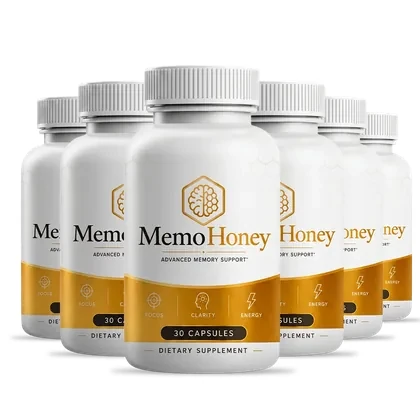
MemoHoney Official Website › Guides › Choosing a Memory Supplement
Label checklistChoosing a Memory Supplement: A 10-Point Label Checklist
Choosing a memory supplement comes down to ten label checks: every row has an amount, the serving is stated, the amounts sit near what research used, nutrients stay under their upper limits, a caution and a responsible company are named, and a refund window is written down.
Below: each check explained, how to use them on any bottle, and MemoHoney scored honestly against all ten.
What this checklist covers
Six sections, from why a checklist works to what to do after choosing.
Why a checklist beats a brand name
A label is a document. Read it the way you would read any other document you are about to sign.
The front of the bottle is the least useful part
Memory supplements share a vocabulary: memory, focus, clarity, energy, brain health. The words tell you which shelf a product belongs on and almost nothing about what is inside. Two bottles with the same front can hold very different amounts of very different things.
NCCIH’s evidence digest is blunt about the field: no supplement has been shown convincingly to prevent cognitive decline. That is not a reason to avoid the shelf. It is a reason to judge each bottle by what can be checked, rather than by what it promises.
The NIH Office of Dietary Supplements and NCCIH both give the same practical advice: read the label, know what is in the product and how much, and treat a claim with care. A checklist turns that advice into a routine you can run in five minutes.
- Compare each amount with the research
- Add its nutrients to what you already take
- Know who should not take it
- Know who answers for it, and how to get your money back
The ten label checks
In the order the checks come up when you hold a bottle: panel first, then the research, then the purchase.
- 1
Every row has an amount
A panel that prints an amount beside each ingredient can be compared with the research. A list of names, or a blend with one total, cannot.
- 2
Serving and servings are stated
Serving size and servings per container tell you what the amounts refer to and how long a bottle lasts.
- 3
Other ingredients are listed
The capsule shell and the flow agents belong on the label too, and they settle questions about vegetarian or allergen-free claims.
- 4
The advertising matches the panel
The ingredient list in the adverts should be the list on the panel. A mismatch is not dangerous, but it tells you which document to trust.
- 5
Amounts sit near the research
Look up what the trials used. An amount far below the tested dose is a different product from the one the study describes.
- 6
Nutrients stay under upper limits
Vitamins with an upper intake, niacin among them, should sit well under it. The adult upper intake for niacin from supplements is 35 mg a day.
- 7
A caution names who should not take it
Pregnancy, age, medical conditions and the dose not to exceed, in plain words.
- 8
A responsible company is named
The label should name the manufacturer or distributor, so there is someone to answer for it.
- 9
An independent testing mark
A mark from an outside programme that tests the finished product against its label.
- 10
A refund window with a route
A stated number of days, a named route to claim and a one-time price you can see.
Six red flags on a memory supplement label
The ten checks find a good label. These six find a bad one quickly, often before the panel is even turned round.
A blend with one total
A proprietary blend lists names under one combined weight, so no single ingredient’s amount can be read, and none can be compared with a trial.
A disease claim
A supplement may say it supports memory. It may not say it treats, cures or prevents dementia or any other disease; the FDA’s rules for supplements reserve that for medicines. A bottle that claims it is breaking the rules it is sold under.
“Clinically proven”, with no trial named
A real trial has authors, a journal and a record on PubMed. A claim that names none of them cannot be checked, and should be read as advertising.
A price that renews itself
An order that quietly becomes a monthly subscription. Look for the words one-time, or for the renewal terms, before you pay.
No caution, no company
A label without a warning block or a named manufacturer or distributor leaves nobody answerable for what is in the bottle.
Results promised in days
Memory trials run for weeks, months or years. A bottle promising a sharper memory by the weekend is promising what no trial in this field has shown.
Every row carries its own amount, the front claims memory support rather than a disease, the order is a one-time payment, the caution block and the distributor line are both printed, and nothing on the bottle promises a result by a date.
Using the checklist in a shop or online
Six habits that make the checklist quick.
Online
Find the Supplement Facts image on the product page, not the ingredient list in the description. Zoom in until every row is readable.
In a shop
Turn the bottle round. The panel is usually beside the directions, and the caution is under it.
Looking up doses
Search PubMed for the ingredient and a trial; note the amount a day and the number of weeks. The ingredient pages on this website do this for MemoHoney.
Adding up nutrients
Write down every vitamin row across the products you take. Niacin is the one most worth adding: the NIH fact sheet gives its limits.
Reading the marks
A GMP or registered-facility mark is about the factory. A product-testing mark names the programme that tested the bottle.
Reading the terms
Days, route, and whether the order renews by itself. A one-time payment and a phone number are worth more than a large number of days.
How MemoHoney scores
The same ten checks, applied to MemoHoney without favour.
It passes every check the panel can answer except one, and the purchase checks. It misses the advertising match, the research doses and an independent testing mark.
| Check | MemoHoney | What the label shows |
|---|---|---|
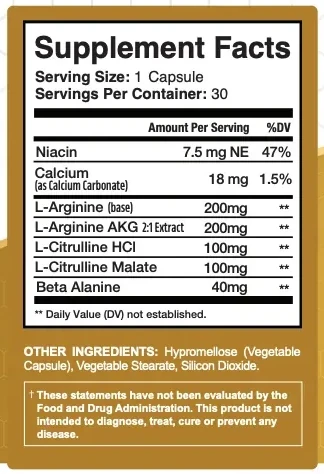
| 1. Every row has an amount | Met | Seven rows, an amount on each. |
| 2. Serving and servings are stated | Met | One capsule a serving, thirty servings. |
| 3. Other ingredients are listed | Met | Hypromellose, vegetable stearate, silicon dioxide. |
| 4. The advertising matches the panel | Not met | Six advertised names; the panel adds calcium. |
| 5. Amounts sit near the research | Not met | Amino-acid rows in milligrams; trials in grams. |
| 6. Nutrients stay under upper limits | Met | Niacin 7.5 mg NE, 47% DV. |
| 7. A caution names who should not take it | Met | Pregnant or nursing, under 18, a known condition. |
| 8. A responsible company is named | Met | Instituto Experience, Ogden, Utah. |
| 9. An independent testing mark | Not met | Process and origin marks only. |
| 10. A refund window with a route | Met | 60 days, one call, one-time payment. |
The three misses, stated once
The advertising names six ingredients and the panel prints seven; the extra row is calcium, 18 mg. The panel is the one to trust, and it is complete.
The amino-acid rows are printed in milligrams, from 40 to 200 mg, while the trials behind those ingredients used grams: 6.4 g of arginine a day in the one cognition pilot, 2.4 g of beta-alanine in the older-adult imaging trial. No trial has tested this capsule.
The seller’s ten marks are process, origin and free-from statements; none of them is a product-testing mark. Where it scores well, it scores on the things a buyer relies on most: a complete panel, a niacin amount well inside its limit, a clear caution, a named distributor and a 60-day window with a route.
After you choose
Choosing is the first half. Four steps make the second half fair.
- 1
Check the bottle on arrival
Seal, front, panel and lot. The bottle check takes two minutes.
- 2
Write a baseline
Three lines on day one: focus, lost words, sleep. The same three lines later are your comparison.
- 3
Keep the routine fixed
Same time, same water, same meal, every day, for several weeks.
- 4
Decide inside the window
For MemoHoney, 60 days from purchase, with the seller’s 30-day condition met at the end of bottle one.
Sources for this checklist
The public guidance and research behind each check.
- Institute of Medicine (US) Standing Committee on the Scientific Evaluation of Dietary Reference Intakes. Niacin. In: Dietary Reference Intakes for Thiamin, Riboflavin, Niacin, Vitamin B6, Folate, Vitamin B12, Pantothenic Acid, Biotin, and Choline. Washington (DC): National Academies Press; 1998. Defines niacin equivalents (NE) and sets the adult tolerable upper intake at 35 mg/day from supplements, with flushing as the critical effect. NCBI Bookshelf NBK114304. https://www.ncbi.nlm.nih.gov/books/NBK114304/
- Niacin: Fact Sheet for Health Professionals. Office of Dietary Supplements, National Institutes of Health. https://ods.od.nih.gov/factsheets/Niacin-HealthProfessional/
- Teotia S, Rana AK, Gupta V. Comparison of the Safety and Efficacy of Oral L-arginine for the Treatment of Cognitive Impairment in Older Adults: A Prospective, Randomized, Placebo-Controlled Pilot Study. Cureus. 2026;18(7):e112987. Thirty-eight participants, oral L-arginine 6.4 g/day for 30 days. PMID 42621366. https://pubmed.ncbi.nlm.nih.gov/42621366/
- Ostfeld I, Zamir A, Ben-Zeev T, et al. beta-Alanine supplementation improves fractional anisotropy scores in the hippocampus and amygdala in 60-80-year-old men and women. Exp Gerontol. 2024;194:112513. Twenty participants at 2.4 g a day. PMID 38971131. https://pubmed.ncbi.nlm.nih.gov/38971131/
- Using Dietary Supplements Wisely. National Center for Complementary and Integrative Health, National Institutes of Health. https://www.nccih.nih.gov/health/using-dietary-supplements-wisely
- Dietary Supplements: What You Need to Know. Office of Dietary Supplements, National Institutes of Health. https://ods.od.nih.gov/factsheets/WYNTK-Consumer/
- Questions and Answers on Dietary Supplements. U.S. Food and Drug Administration. https://www.fda.gov/food/information-consumers-using-dietary-supplements/questions-and-answers-dietary-supplements
- Dietary Supplements and Cognitive Function, Dementia, and Alzheimer's Disease: What the Science Says. National Center for Complementary and Integrative Health, National Institutes of Health. https://www.nccih.nih.gov/health/providers/digest/dietary-supplements-and-cognitive-function-dementia-and-alzheimers-disease-science