MemoHoney Official Website › Guides › Memory Supplement Guide
Evidence guideMemory Supplement Guide: What the Evidence Supports
Memory supplements have been tested in large trials, and the results are modest: a three-year trial in over two thousand older adults found a small benefit on overall cognition from a daily multivitamin and none from cocoa extract. Dose, duration and sleep matter more than any single ingredient name.
This guide covers what the big trials found, why amounts and weeks decide a result, and the everyday causes of memory trouble worth ruling out first.
What this guide covers
Seven sections, from the label to the evidence and back.
What “memory support” means on a label
Two words on the front of a bottle carry a precise legal meaning.
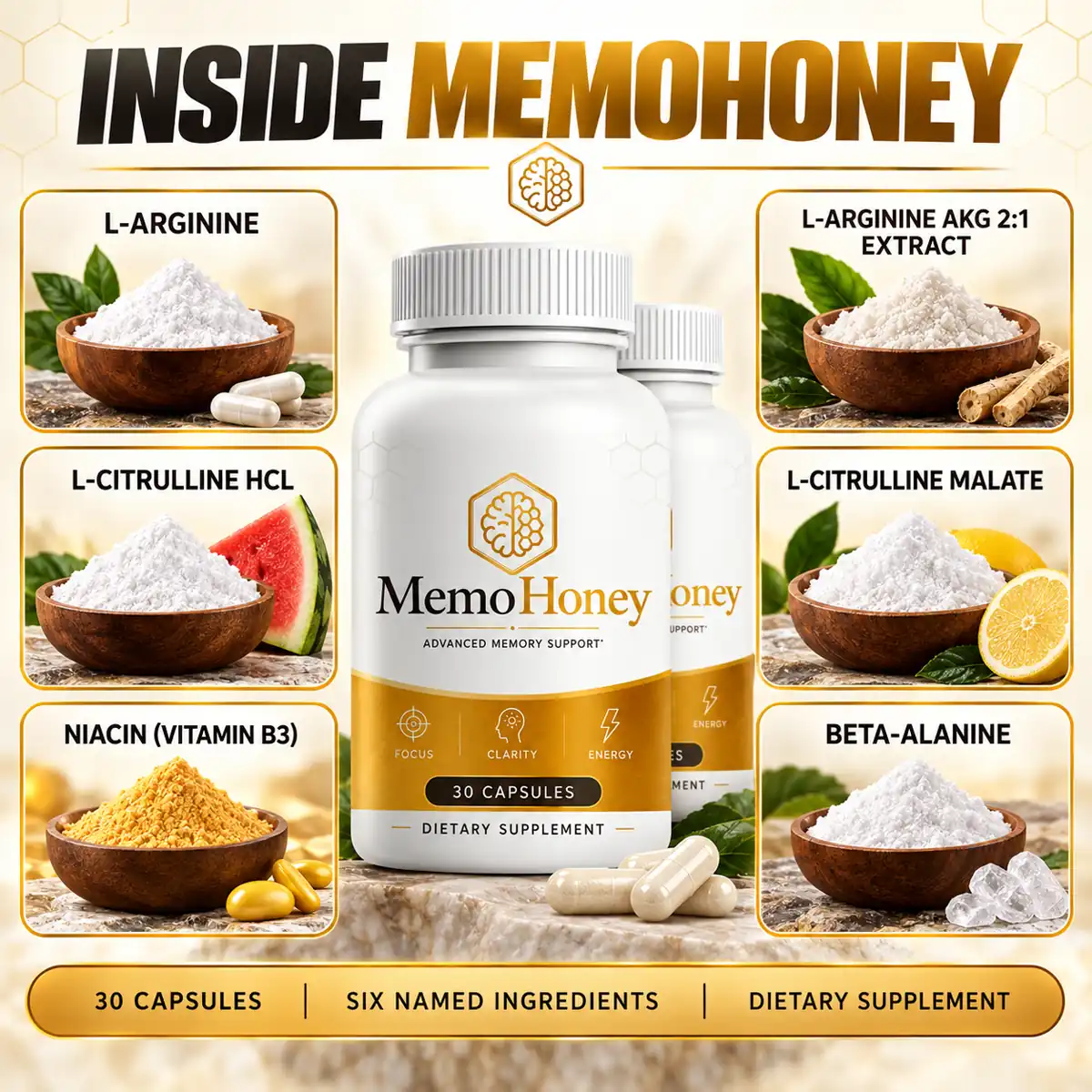
A supplement label may describe how a product supports a normal function of the body, such as memory, focus or energy. It may not claim to treat, cure or prevent a disease, and it must carry the FDA statement that the claim has not been evaluated by the agency.
The FDA’s questions and answers set out the division of responsibility: supplements are not approved before they are sold, and the company that sells one is responsible for its label and its safety. So “Advanced Memory Support” on a bottle is a statement of purpose, and the panel underneath is where the substance is.
The practical reading is simple. The front of the bottle tells you what the product is for. The Supplement Facts panel tells you what is in it, and in what amount. Everything useful in this guide depends on the second.
- The front: the purpose, in structure and function language
- The panel: every ingredient and its amount per serving
- The caution: who should not take it, and the dose not to exceed
What the large trials found
Four studies, from the largest to the smallest, and what each one actually measured.
| Study | What was given | Who | How long | What it found |
|---|---|---|---|---|
| COSMOS-Mind | Cocoa extract (500 mg flavanols a day) or a daily multivitamin, against placebo | About 2,200 adults aged 65 and over | 3 years | A small benefit on global cognition from the multivitamin; none from cocoa extract |
| COSMOS clinic sub-cohort | The same multivitamin, tested in person | The in-clinic subgroup, pooled with two sister studies | 2 to 3 years | Pooled across three COSMOS studies, a small benefit on global cognition and episodic memory |
| Arginine pilot | L-arginine 6.4 g a day, against placebo | 38 older adults with cognitive impairment | 30 days | A pilot: small, short, and a first look rather than an answer |
| Beta-alanine imaging trial | Beta-alanine 2.4 g a day | 20 adults aged 60 to 80 | 10 weeks | Changes in brain-imaging scores in memory regions; an imaging result, not a memory test |
The first two rows are the largest supplement trials of cognition in recent years. The last two are small and early.
Reading the COSMOS results
COSMOS-Mind is the trial to know. Over two thousand adults aged 65 and over were randomly assigned to cocoa extract, a daily multivitamin, both, or placebo, and their cognition was tested every year for three years. The multivitamin produced a small benefit on global cognition; the cocoa extract produced none.
The clinic sub-cohort analysis tested a subgroup in person and pooled the result with two sister studies. Across all three, the multivitamin again came out slightly ahead on global cognition and episodic memory. Two features of these trials matter more than the headline: they ran for years, and they measured memory with standard tests rather than asking people how they felt.
The largest trials in this field ran for years, and the effects they found were small.The summary this guide keeps returning to
What the evidence reviews conclude
Evidence reviews pool many trials. Here is where they land.
The NIH digest
NCCIH’s evidence digest on supplements and cognition reviews ginkgo, omega-3s, B vitamins and more. Its conclusion is that no supplement has been shown convincingly to prevent cognitive decline or dementia.Carnosine and recall
A 2024 meta-analysis of histidine-containing dipeptides, the family carnosine belongs to, found an improvement in delayed recall across the pooled trials. Beta-alanine is the building block the body uses to make carnosine.
Niacin from food
The Chicago Health and Aging Project followed older adults and found that more niacin from food went with slower cognitive decline. It is an observational study of diet, not a capsule trial.
What that adds up to
A handful of real signals, most of them small, most of them from food or from doses and durations well beyond a single daily capsule. That is the honest map of the field.
Why dose and duration decide everything
Two numbers settle most questions about a memory supplement, and neither is on the front of the bottle.
Dose
Every amino-acid trial in this field is dosed in grams: arginine at 6.4 g a day, beta-alanine at 2.4 g a day. A label amount in milligrams is a different order of magnitude, and it deserves to be read as one.
Duration
Beta-alanine raises muscle carnosine over weeks: the sports-nutrition position stand sets at least four weeks of daily use. COSMOS ran for three years. A week is too short to judge anything.
Measurement
A trial measures memory with a test given the same way every time. A buyer judging a supplement at home has only impressions, which is why a written baseline on day one helps so much.
Look for the amount on each row, look up the amount the research used, and plan to give any product several weeks of the same daily routine before deciding. Those three habits do more than any ingredient list.
Where sleep, hearing and medicines come in
MedlinePlus lists several common, treatable causes of memory trouble. Each is worth ruling out before a supplement.
Sleep
Memory is consolidated during sleep. A run of short or broken nights shows up as a foggy day and a lost word before it shows up anywhere else.
Medicines
MedlinePlus lists medicine side effects among the common, treatable causes of memory trouble. A new prescription is worth mentioning when a memory complaint is.Vitamin B12 and thyroid
Both are on the MedlinePlus list of treatable causes, and both are checked with an ordinary blood test.
Stress, anxiety and low mood
Each makes a person more forgetful, and each is worth treating in its own right.
Hearing and attention
A sentence that was never heard clearly is never stored. Hearing and concentration come before recall, not after it.
Alcohol
Heavy drinking is on the same list, and the one item on it that is entirely in a reader’s own hands.
Reading a memory supplement label
Four steps, in the order the panel is printed. The 10-point checklist takes them further.
- 1
Find the serving
Serving size and servings per container, at the top of the panel. Everything below is per serving.
- 2
Read every row
Each ingredient with its amount. A row with an amount can be compared with the research; a name alone cannot.
- 3
Check the nutrient rows
Vitamins and minerals carry a %DV. Add them to what you already take, especially any with an upper intake, such as niacin.
- 4
Read the caution
Who should not take it, the dose not to exceed, and the seal line.
Where MemoHoney fits
A label that shows its amounts is a label you can check. Here is how this one reads against the guide.
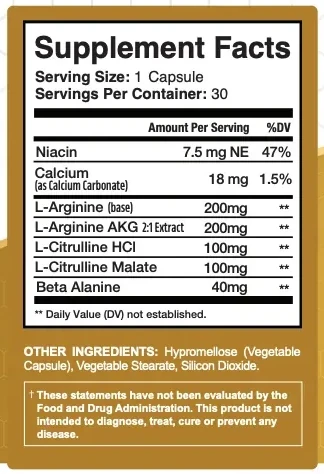
MemoHoney is a once-daily capsule sold for memory support, with focus, clarity and energy named on the label. What sets its label apart is the panel: seven rows, an amount on every one. Niacin 7.5 mg NE (47% DV), calcium 18 mg, L-arginine 200 mg, arginine AKG 200 mg, two citrulline forms at 100 mg each and beta alanine 40 mg.
That makes it a label a reader can do everything in this guide with: find the serving, read each row, add up the niacin, read the caution. The ingredients page sets each row beside the research, and the Supplement Facts page prints the panel in full.
Taken the way the label asks, one capsule with 8 oz of water before a meal, a bottle lasts 30 days, and the 60-day window from purchase leaves time for the several weeks this guide recommends.
Sources for this guide
Every study named in this guide, linked to its public record.
- Baker LD, Manson JE, Rapp SR, et al. Effects of cocoa extract and a multivitamin on cognitive function: A randomized clinical trial. Alzheimers Dement. 2023;19(4):1308-1319. Cocoa extract at 500 mg/day of flavanols, and a commercial multivitamin, over three years. PMID 36102337. https://pubmed.ncbi.nlm.nih.gov/36102337/
- Vyas CM, Manson JE, Sesso HD, et al. Effect of multivitamin-mineral supplementation versus placebo on cognitive function: results from the clinic subcohort of the COcoa Supplement and Multivitamin Outcomes Study (COSMOS) randomized clinical trial and meta-analysis of 3 cognitive studies within COSMOS. Am J Clin Nutr. 2024;119(3):692-701. PMID 38244989. https://pubmed.ncbi.nlm.nih.gov/38244989/
- Dietary Supplements and Cognitive Function, Dementia, and Alzheimer's Disease: What the Science Says. National Center for Complementary and Integrative Health, National Institutes of Health. https://www.nccih.nih.gov/health/providers/digest/dietary-supplements-and-cognitive-function-dementia-and-alzheimers-disease-science
- MedlinePlus. Memory. Bethesda (MD): U.S. National Library of Medicine, National Institutes of Health. https://medlineplus.gov/memory.html
- Teotia S, Rana AK, Gupta V. Comparison of the Safety and Efficacy of Oral L-arginine for the Treatment of Cognitive Impairment in Older Adults: A Prospective, Randomized, Placebo-Controlled Pilot Study. Cureus. 2026;18(7):e112987. Thirty-eight participants, oral L-arginine 6.4 g/day for 30 days. PMID 42621366. https://pubmed.ncbi.nlm.nih.gov/42621366/
- Ostfeld I, Zamir A, Ben-Zeev T, et al. beta-Alanine supplementation improves fractional anisotropy scores in the hippocampus and amygdala in 60-80-year-old men and women. Exp Gerontol. 2024;194:112513. Twenty participants at 2.4 g a day. PMID 38971131. https://pubmed.ncbi.nlm.nih.gov/38971131/
- Trexler ET, Smith-Ryan AE, Stout JR, et al. International society of sports nutrition position stand: Beta-Alanine. J Int Soc Sports Nutr. 2015;12:30. Four to six grams daily for at least four weeks, with paraesthesia the one reported side effect. PMID 26175657. https://pubmed.ncbi.nlm.nih.gov/26175657/
- Bell SM, Hariharan R, Laud PJ, et al. Histidine-containing dipeptide supplementation improves delayed recall: a systematic review and meta-analysis. Nutr Rev. 2024;82(10):1372-1385. PMID 38013229. https://pubmed.ncbi.nlm.nih.gov/38013229/
- Morris MC, Evans DA, Bienias JL, et al. Dietary niacin and the risk of incident Alzheimer's disease and of cognitive decline. J Neurol Neurosurg Psychiatry. 2004;75(8):1093-9. An observational study of niacin from FOOD, not from capsules. PMID 15258207. https://pubmed.ncbi.nlm.nih.gov/15258207/
- Questions and Answers on Dietary Supplements. U.S. Food and Drug Administration. https://www.fda.gov/food/information-consumers-using-dietary-supplements/questions-and-answers-dietary-supplements