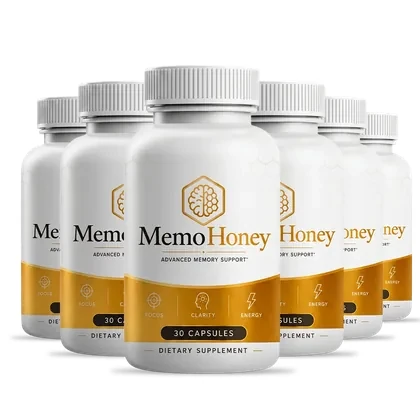
MemoHoney Official Website › Ingredients
The formula, row by rowMemoHoney Ingredients: What Each of the Seven Rows Does
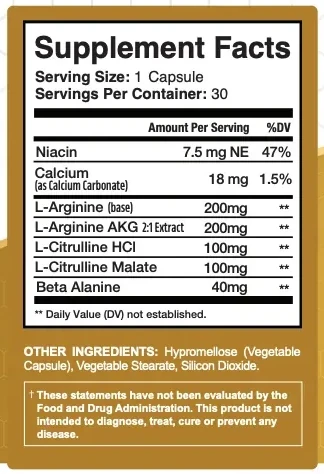
MemoHoney puts seven ingredients in each capsule, and the label prints an amount for every one: 200 mg L-arginine, 200 mg L-arginine AKG, 100 mg L-citrulline HCl, 100 mg L-citrulline malate, 40 mg beta alanine, 7.5 mg niacin and 18 mg calcium.
Five are amino-acid forms, printed at 640 mg between them. Niacin covers 47% of the Daily Value, and calcium is the seventh row, the one the advertising leaves off.
Each row below comes with what it does in the body, the chemical form it is sold in, the capsule around it and the paper where its research starts.
MemoHoney ingredients at a glance
Seven printed rows, one capsule a day. The tiles give the totals; the cards further down give each row on its own.
Read the panel as three groups. Four rows are arginine and citrulline in two forms each, printed at 600 mg between them, and they all feed the same nitric-oxide cycle. One row is beta alanine, the building block of carnosine. Two rows are nutrients with a Daily Value, niacin and calcium, and those are the only two that carry a percentage. One capsule is the day's serving, so the numbers on the panel are also the numbers for the day.
The seven MemoHoney rows and their printed amounts
Name, amount, Daily Value, what the compound does, and the first paper to read on it. The tags colour-code amino acids, the vitamin and the mineral.
Niacin
vitamin B3A B vitamin the body uses to make NAD, the coenzyme behind energy metabolism in every cell. Source: the Institute of Medicine's reference intakes for niacin.
Calcium
as calcium carbonateA mineral, printed on the panel and left off every advertised list. 18 mg is the smallest nutrient amount on the label. Source: the NIH fact sheet on calcium.
L-Arginine
baseThe amino acid the body converts to nitric oxide, the signal that relaxes blood-vessel walls. Source: the one arginine cognition pilot.
L-Arginine AKG
2:1 extractArginine bound to alpha-ketoglutarate, the pre-workout form. Part of the 200 mg is the carrier, so the arginine in this row is less than 200 mg. Source: the AAKG pharmacokinetic and performance trial.
L-Citrulline HCl
hydrochlorideThe amino acid the kidneys recycle back into arginine; taken by mouth it raises blood arginine further than arginine itself. Source: the citrulline blood-pressure meta-analysis.
L-Citrulline Malate
citrulline + malic acidCitrulline bound to malic acid, the endurance form sold in sports powders. Source: the older-women pilot.
Beta Alanine
beta-alanineThe building block of carnosine, a dipeptide stored in muscle and brain. Source: the older-adult imaging trial.
A Daily Value exists only for nutrients with an established requirement. Arginine, citrulline and beta alanine are amino acids the body also makes for itself, so no Daily Value is set for them, and the label says so with its 'not established' mark rather than a number. Niacin and calcium are essential nutrients with adult Daily Values, so they carry a percentage: 7.5 mg NE is 47% of the 16 mg NE niacin figure, and the label prints 1.5% for the 18 mg of calcium (about 1.4% of today's 1,300 mg figure).
What the 'Inside MemoHoney' graphic shows, and the seventh row
The graphic and the panel agree on six names. The panel is the complete list, and the one extra row is small.
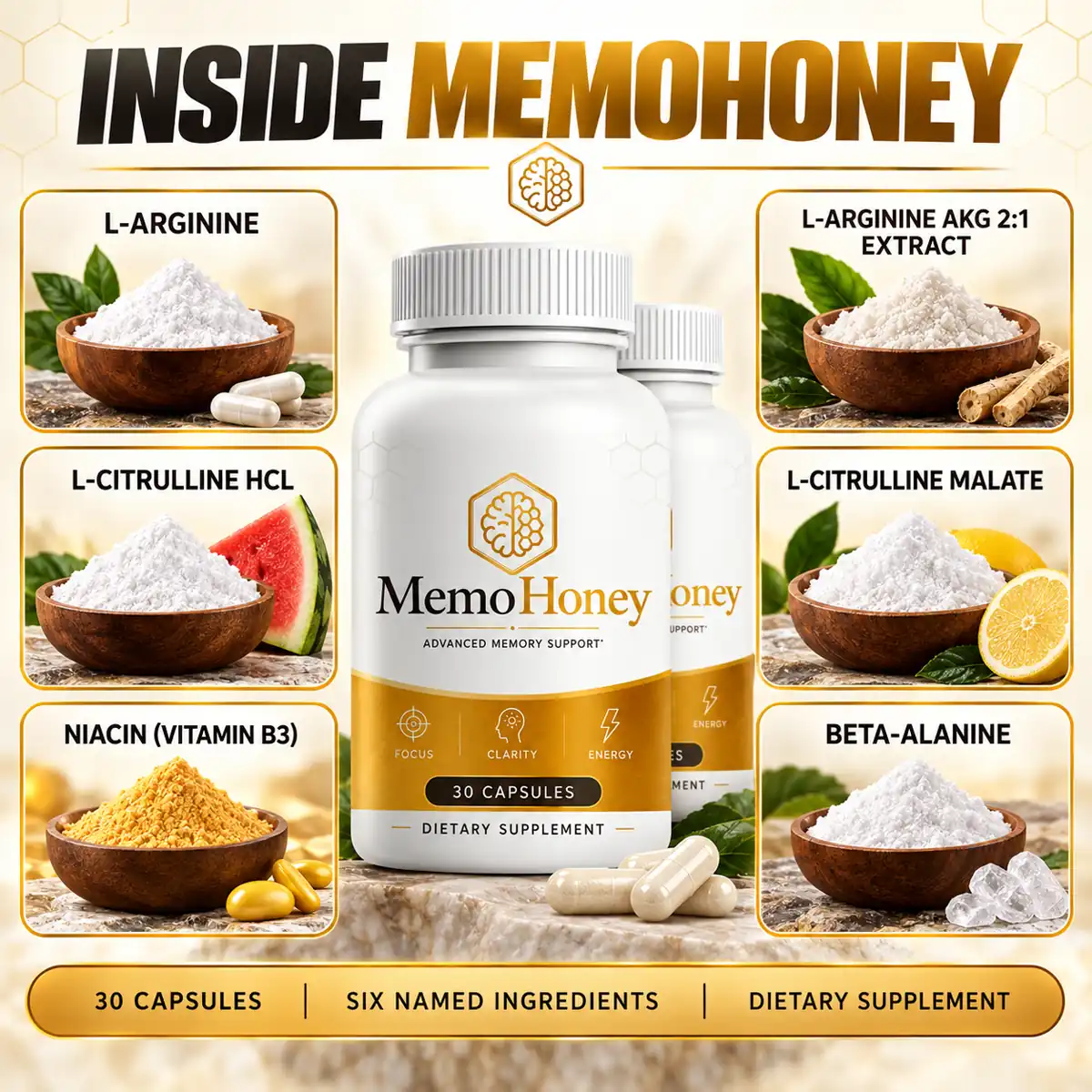
The seller's graphic arranges six names around the bottles: L-arginine, L-arginine AKG 2:1 extract, L-citrulline HCl, L-citrulline malate, niacin (vitamin B3) and beta-alanine. Those are the six the product is advertised on, and all six are on the panel with the amounts on the cards above.
The panel adds a seventh row: calcium, 18 mg, as calcium carbonate, at 1.5% of the Daily Value. It is the smallest nutrient amount on the label. For scale, the NIH puts a glass of milk at roughly 300 mg of calcium, so this row adds a little to the day rather than covering it.
Calcium carbonate is the common, compact form of calcium, and the NIH calcium fact sheet notes that it is absorbed best with food. The label's timing, one capsule 20 to 30 minutes before a meal, puts it close to one.
The five MemoHoney amino acids, form by form
Two arginine forms, two citrulline forms and beta alanine: five rows printed at 640 mg, of which about 520 to 540 mg is amino acid once the AKG, hydrochloride and malate carriers are counted out. Each form was chosen for a reason.
| Panel row | Per capsule | The form | Where it occurs in food |
|---|---|---|---|
| L-Arginine (base) | 200 mg | The free amino acid, nothing attached | Meat, fish, dairy, nuts, beans |
| L-Arginine AKG 2:1 | 200 mg | Arginine bound to alpha-ketoglutarate, two parts to one | A manufactured salt; not a food form |
| L-Citrulline HCl | 100 mg | Citrulline as a hydrochloride salt | Watermelon, which gave citrulline its name |
| L-Citrulline Malate | 100 mg | Citrulline bound to malic acid | Malic acid is the sour note in apples |
| Beta Alanine | 40 mg | A non-protein amino acid, the carnosine precursor | Meat and fish, as carnosine and anserine |
Why two forms of arginine
Plain L-arginine is the amino acid on its own. The AKG row is arginine joined to alpha-ketoglutarate, a compound from the citric-acid cycle that cells use to release energy. It is the form sold in pre-workout powders and the one tested in the AAKG pharmacokinetic trial. Part of that row's 200 mg is the carrier, so the arginine it supplies is less than 200 mg.
Why citrulline sits beside arginine
Arginine swallowed as a powder is partly broken down in the gut and the liver before it reaches the blood. Citrulline passes through and is turned back into arginine by the kidneys. In the head-to-head pharmacokinetic trial, oral citrulline raised blood arginine further than the same amount of arginine did, which is why formulas pair the two.
Why two forms of citrulline
The hydrochloride is a simple salt that keeps the powder stable. The malate form is the one sports nutrition uses, citrulline joined to malic acid. Both deliver citrulline; together the two rows print 200 mg of citrulline forms. Because each carries its acid partner, the citrulline itself is about 140 to 155 mg.
Why beta alanine is the smallest amino row
Beta alanine is the building block the body joins to histidine to make carnosine, a compound stored in muscle and brain. At larger servings it is known for a harmless tingle, described in the sports-nutrition position stand. At 40 mg it sits far below that range.
The two MemoHoney rows with a Daily Value: niacin and calcium
Niacin and calcium are essential nutrients, so the label can say how much of the day each capsule covers.
What NE means on the niacin row
NE stands for niacin equivalents, the unit set in the Institute of Medicine reference intakes. One NE is 1 mg of niacin, or 60 mg of the amino acid tryptophan, which the body can turn into niacin. Labels use it so niacin from different sources can be added up.
Why niacin is the only row near its limit
Niacin is the one ingredient here with a tolerable upper intake: 35 mg a day from supplements for adults, set on flushing, the warm red skin that larger doses cause. At 7.5 mg the capsule is about a fifth of that, and the NIH niacin fact sheet covers what else in a day counts toward it.
What else is in a MemoHoney capsule
The label's other-ingredients line reads: Hypromellose (vegetable capsule), vegetable stearate, silicon dioxide. Three working parts, none of them an active.
Hypromellose (vegetable capsule)
The shell. Hypromellose is made from plant cellulose rather than gelatin, which is what the seller’s vegetarian mark rests on.
Vegetable stearate
A plant-derived fatty-acid salt, used in tiny amounts, that keeps the powder from sticking to the filling machines, so every capsule gets its share.
Silicon dioxide
Silica, a flow agent that stops fine powders from clumping in the bottle. It is the same compound found in sand and many foods.
Nothing on the panel or the other-ingredients line is milk-derived, and amino acids, niacin and calcium carbonate carry no gluten, which matches the dairy-free and gluten-free marks in the seller’s artwork. The bottle label itself prints none of those marks, only its origin line. What each seal is a statement about is set out on testing and quality.
How the MemoHoney amounts compare with the research
Stated once, with the numbers, so the rest of the page can describe what the ingredients do.
The research on these compounds was dosed in grams. The one arginine study with a cognition endpoint gave 6.4 g a day; the citrulline blood-pressure trials ran from 3 to 9 g; the older-adult beta-alanine imaging trial gave 2.4 g. The panel prints 40 to 200 mg per amino-acid row, so every amino-acid row sits at somewhere between a sixtieth and a thirtieth of the amount the research used, and no published trial has tested this capsule.
Niacin is the exception: 7.5 mg is an ordinary nutrition-label amount, sized to the Daily Value rather than to a trial. The full row-by-row comparison, with each source linked, is in the dose table on the Supplement Facts page.
MemoHoney ingredient questions
What are the ingredients in MemoHoney?
Seven rows per capsule: niacin 7.5 mg NE, calcium 18 mg as calcium carbonate, L-arginine 200 mg, L-arginine AKG 2:1 extract 200 mg, L-citrulline HCl 100 mg, L-citrulline malate 100 mg and beta alanine 40 mg. The capsule is hypromellose, with vegetable stearate and silicon dioxide.
Why does the MemoHoney advertising list six ingredients when the label has seven?
The advertising names the six functional ingredients and leaves off calcium, 18 mg as calcium carbonate. The Supplement Facts panel is the complete list.
Does MemoHoney contain caffeine or any stimulant?
No. None of the seven rows is a stimulant, and caffeine appears nowhere on the panel or the other-ingredients line.
How much niacin is in MemoHoney?
7.5 mg NE per capsule, 47% of the adult Daily Value and about a fifth of the 35 mg upper intake for supplemental niacin.
Sources for the MemoHoney ingredients page
Every paper linked on this page, in the order the rows appear.
- Institute of Medicine (US) Standing Committee on the Scientific Evaluation of Dietary Reference Intakes. Niacin. In: Dietary Reference Intakes for Thiamin, Riboflavin, Niacin, Vitamin B6, Folate, Vitamin B12, Pantothenic Acid, Biotin, and Choline. Washington (DC): National Academies Press; 1998. Defines niacin equivalents (NE) and sets the adult tolerable upper intake at 35 mg/day from supplements, with flushing as the critical effect. NCBI Bookshelf NBK114304. https://www.ncbi.nlm.nih.gov/books/NBK114304/
- Niacin: Fact Sheet for Health Professionals. Office of Dietary Supplements, National Institutes of Health. https://ods.od.nih.gov/factsheets/Niacin-HealthProfessional/
- Calcium: Fact Sheet for Health Professionals. Office of Dietary Supplements, National Institutes of Health. https://ods.od.nih.gov/factsheets/Calcium-HealthProfessional/
- Schwedhelm E, Maas R, Freese R, et al. Pharmacokinetic and pharmacodynamic properties of oral L-citrulline and L-arginine: impact on nitric oxide metabolism. Br J Clin Pharmacol. 2008;65(1):51-9. Citrulline 3 g twice daily raised trough plasma arginine furthest. PMID 17662090. https://pubmed.ncbi.nlm.nih.gov/17662090/
- Teotia S, Rana AK, Gupta V. Comparison of the Safety and Efficacy of Oral L-arginine for the Treatment of Cognitive Impairment in Older Adults: A Prospective, Randomized, Placebo-Controlled Pilot Study. Cureus. 2026;18(7):e112987. Thirty-eight participants, oral L-arginine 6.4 g/day for 30 days. PMID 42621366. https://pubmed.ncbi.nlm.nih.gov/42621366/
- Campbell B, Roberts M, Kerksick C, et al. Pharmacokinetics, safety, and effects on exercise performance of L-arginine alpha-ketoglutarate in trained adult men. Nutrition. 2006;22(9):872-81. Four grams three times daily, 12 g/day for eight weeks. PMID 16928472. https://pubmed.ncbi.nlm.nih.gov/16928472/
- Barkhidarian B, Khorshidi M, Shab-Bidar S, et al. Effects of L-citrulline supplementation on blood pressure: A systematic review and meta-analysis. Avicenna J Phytomed. 2019;9(1):10-20. Doses ran 3 to 9 g/day, and only the arms at 6 g/day or more moved diastolic pressure. PMID 30788274. https://pubmed.ncbi.nlm.nih.gov/30788274/
- Ramos-Hernández R, Pascual-Fernández J, Alvarez-Pardo S, et al. Short-term citrulline malate supplementation enhances lower-limb function in physically active older women: A pilot randomized controlled trial. Clin Nutr ESPEN. 2026;74:103356. Twenty women aged 60-75, 3 g/day for six weeks alongside exercise. PMID 42162613. https://pubmed.ncbi.nlm.nih.gov/42162613/
- Trexler ET, Smith-Ryan AE, Stout JR, et al. International society of sports nutrition position stand: Beta-Alanine. J Int Soc Sports Nutr. 2015;12:30. Four to six grams daily for at least four weeks, with paraesthesia the one reported side effect. PMID 26175657. https://pubmed.ncbi.nlm.nih.gov/26175657/
- Ostfeld I, Zamir A, Ben-Zeev T, et al. beta-Alanine supplementation improves fractional anisotropy scores in the hippocampus and amygdala in 60-80-year-old men and women. Exp Gerontol. 2024;194:112513. Twenty participants at 2.4 g a day. PMID 38971131. https://pubmed.ncbi.nlm.nih.gov/38971131/