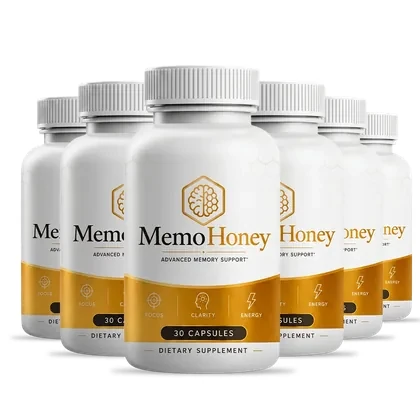
MemoHoney Official Website › Blog › MemoHoney® Ingredients: #1 Doctor Reviewed Seven-Row Label Guide [2026]
Reading the labelMemo Honey Ingredients List: What the Seven Panel Rows Show
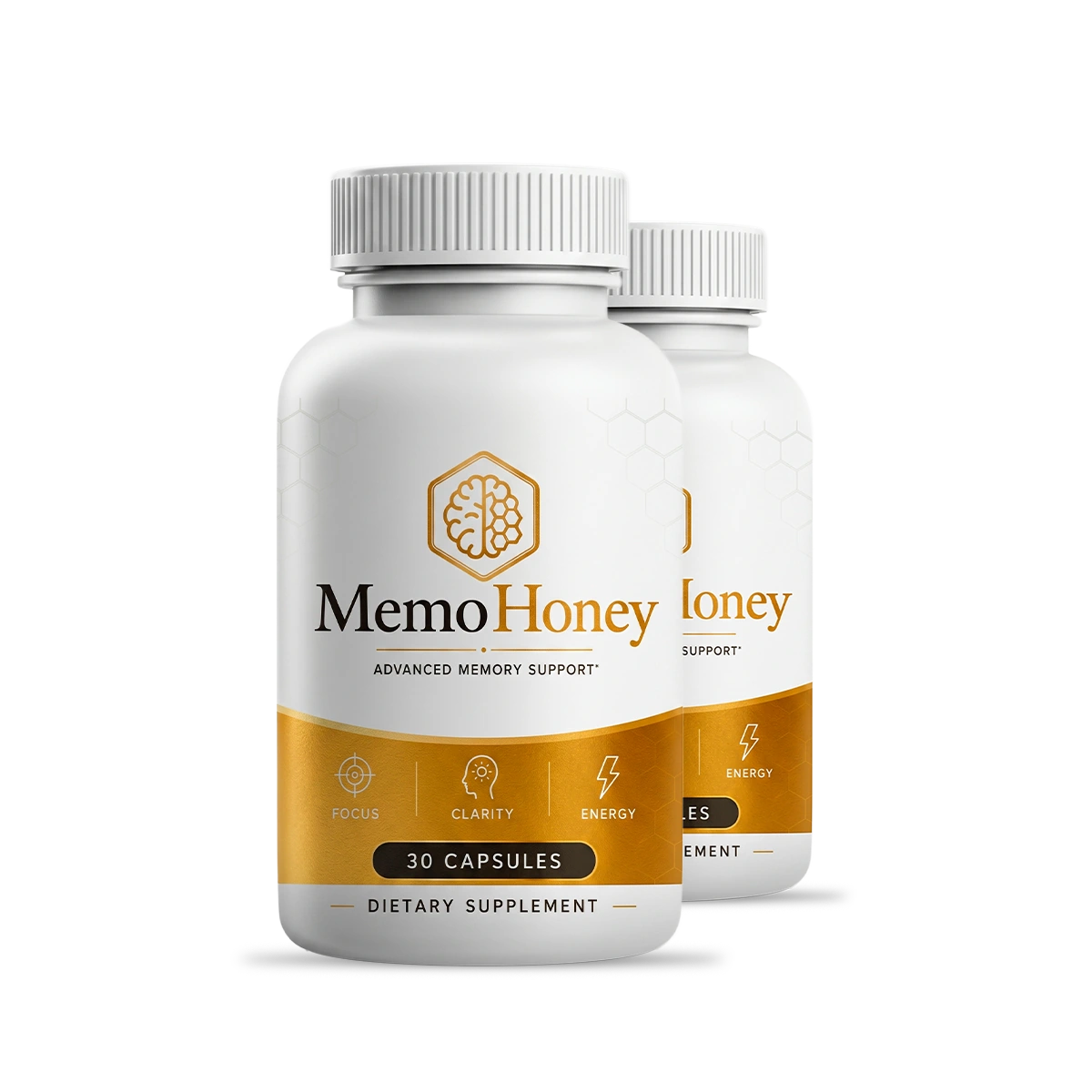
Memo Honey prints seven rows per capsule, and the doses run from 7.5 mg of niacin NE up to 200 mg for each arginine form. Calcium appears only on the panel, not in the advertising names, and the shell is hypromellose. That gap between six names and seven rows is what this page walks through.
A supplement label is two documents: the advertising, which names ingredients, and the panel, which states them. On this bottle they differ by one row.
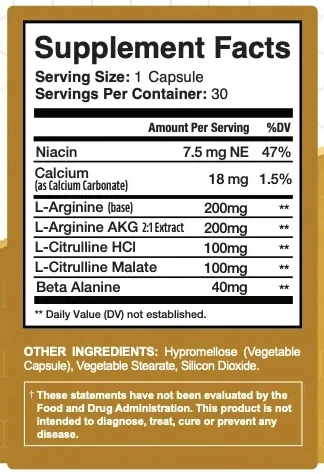
- The panel prints seven rows, each with an amount per capsule.
- Two rows are nutrients with a Daily Value: niacin (47%) and calcium (1.5%).
- Five rows are amino-acid forms, printed at 640 mg in all, with no Daily Value set.
- The advertising names six ingredients; the panel adds calcium.
- Where the two lists differ, the panel is the one to trust.
What a Supplement Facts panel is for
Every dietary supplement sold in the United States carries a Supplement Facts panel. It is the part of the label with rules: a serving size at the top, each ingredient with its amount per serving, and a Daily Value column for the nutrients that have one. The front of the bottle can describe a purpose in a few words. The panel has to state the contents.
That makes it the most useful thing on any bottle, and on MemoHoney it is unusually complete. Every one of its seven rows prints an amount. There is no proprietary blend with a single total, and no ingredient named without a figure beside it. Whatever you want to know about what is in the capsule, the answer is on the panel.
This post reads it from the top down, the way the panel is meant to be read, and then sets it beside the ingredient list the advertising uses.
The top of the panel: one capsule, thirty servings
The first two lines read Serving Size: 1 Capsule, and Servings Per Container: 30. Everything below them is per capsule. The label directions ask for one capsule a day, so the serving and the daily amount are the same thing, and a bottle lasts thirty days.
That is worth stating plainly because not every label works this way. Some panels are written per two or three capsules, and the daily amount is a multiple of what the rows show. Here there is no arithmetic to do: the amounts in the rows are the amounts you take in a day.
The panel then divides into two groups, separated on the label by a heavier rule. Above it sit the nutrients with a Daily Value. Below it sit the five ingredients without one.
The two nutrient rows: niacin and calcium
Niacin comes first: 7.5 mg NE, printed as 47% of the Daily Value. NE stands for niacin equivalents, the unit the Institute of Medicine’s reference intakes use for niacin. The adult Daily Value is 16 mg NE, and 7.5 is just under half of it, which is where the 47% comes from. The same reference sets the adult upper intake from supplements at 35 mg a day, so one capsule carries about a fifth of that ceiling.
Calcium is second: 18 mg, as calcium carbonate, printed as 1.5% of the Daily Value. The NIH fact sheet on calcium gives the adult Daily Value as 1,300 mg, and a glass of milk carries roughly 300 mg. Calcium carbonate is the most common form in supplements, and at 18 mg it reads less like an active ingredient than like a small nutrient amount that comes with the formula.
A %DV can only be printed where a Daily Value exists. Niacin and calcium have one; the five amino acids do not. That is why the panel is split into two groups.
MemoHoney: seven rows you can read before you buy
One capsule a day, an amount printed on every row, thirty capsules to a bottle. Packs of two, three or six, one-time payment.
$79, $69 or $49 a bottle across two, three and six bottles, 60 days on every pack
Choose A MemoHoney PackOne capsule a day, 30 to a bottle. Lot MEM-26/GO-8806, shipped from the United States.
The five amino-acid rows
Below the rule are five amino acids, each with an amount and a mark where the percentage would go. The label explains the mark in its footnote: Daily Value not established. This website writes that out as “no Daily Value set”.
L-arginine, base, 200 mg, is the amino acid the body converts to nitric oxide. L-arginine AKG 2:1 extract, 200 mg, is arginine bound to alpha-ketoglutarate, the form sold in pre-workout powders; its pharmacokinetic trial describes how it behaves. Part of that 200 mg is the carrier, so the arginine in the row is less than the row total.
L-citrulline HCl, 100 mg, and L-citrulline malate, 100 mg, are two forms of the same amino acid. Citrulline is recycled into arginine by the kidneys, and a head-to-head trial found oral citrulline raised blood arginine further than arginine itself. The malate form, citrulline bound to malic acid, is the one studied for exercise in the citrulline malate meta-analysis.
Beta alanine, 40 mg, is the building block of carnosine, a dipeptide stored in muscle and brain; the sports-nutrition position stand covers how it is used. Added together, the five amino-acid rows come to 640 mg a capsule as printed; with the AKG, hydrochloride and malate carriers counted out, the amino acids themselves are about 520 to 540 mg.
Seven rows, six advertised names
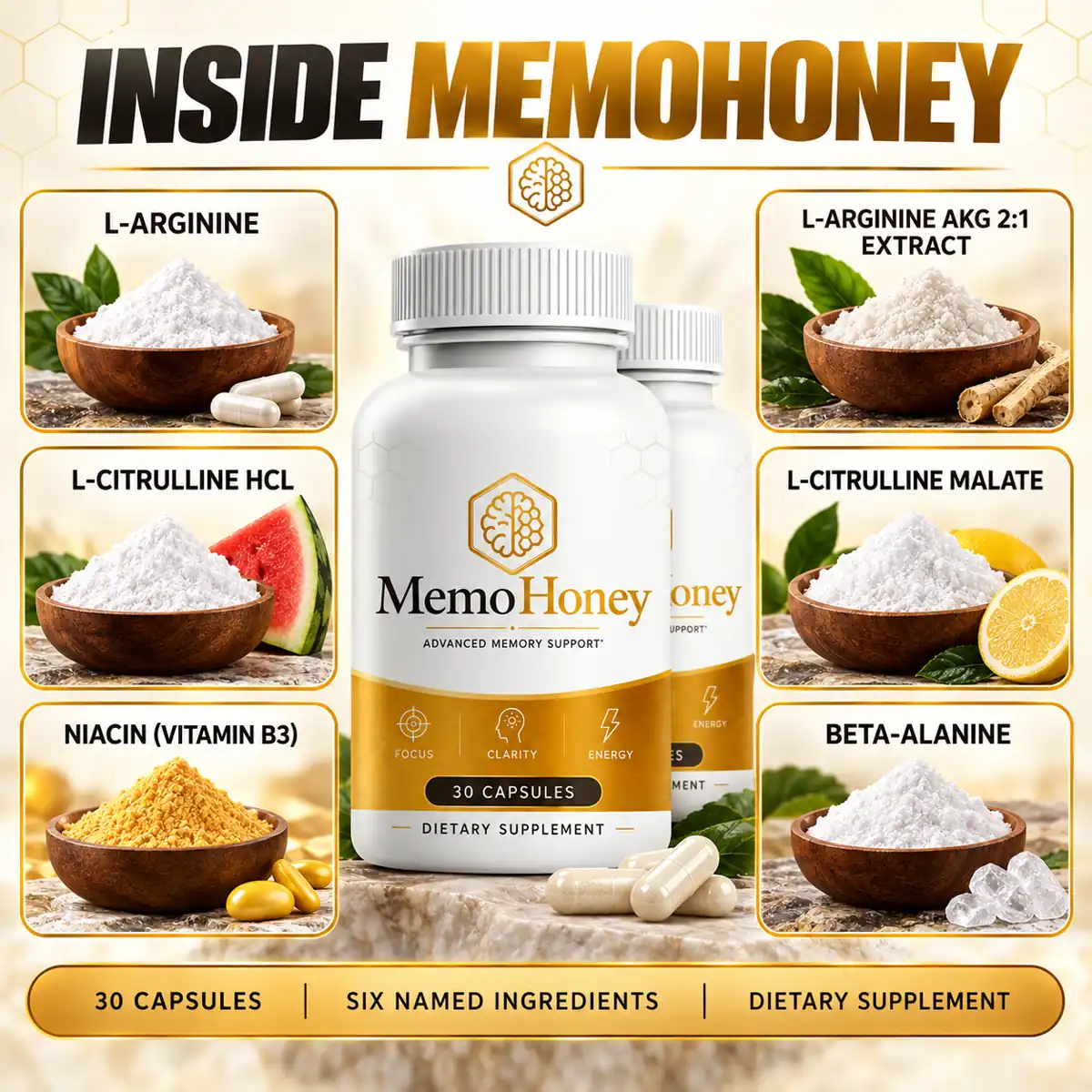
The advertising for MemoHoney, including the Inside MemoHoney artwork shown here, names six ingredients: L-arginine, L-arginine AKG 2:1 extract, L-citrulline HCl, L-citrulline malate, niacin and beta-alanine. The panel prints those six and a seventh, calcium.
Nothing about the difference is alarming. Eighteen milligrams of calcium is a small amount, it comes as calcium carbonate, and it sits on the panel in plain view. The lesson is about which document to read. An ingredient list in an advert is a summary written to sell; the panel is the statement of contents. When they disagree, go with the panel.
| Panel row | Per capsule | % Daily Value | Type | Advertised? |
|---|---|---|---|---|
| Niacin | 7.5 mg NE | 47% | Vitamin | Yes |
| Calcium (as calcium carbonate) | 18 mg | 1.5% | Mineral | No |
| L-Arginine (base) | 200 mg | No Daily Value set | Amino acid | Yes |
| L-Arginine AKG (2:1 extract) | 200 mg | No Daily Value set | Amino acid | Yes |
| L-Citrulline HCl | 100 mg | No Daily Value set | Amino acid | Yes |
| L-Citrulline Malate | 100 mg | No Daily Value set | Amino acid | Yes |
| Beta Alanine | 40 mg | No Daily Value set | Amino acid | Yes |
Copied from the MemoHoney Supplement Facts panel in the label’s own row order; the serving is one capsule and a bottle holds thirty.
What the small print in each row tells you
Three rows carry a word or two in brackets, and each one says something about the chemistry. Calcium is printed as calcium carbonate: the amount on the panel is the calcium itself, and the words in brackets name the compound it arrives in. L-arginine is printed as base, meaning the free amino acid rather than a salt. The AKG row is printed as a 2:1 extract, the usual way of describing arginine paired with alpha-ketoglutarate in a fixed ratio.
The two citrulline rows do the same job with their names. HCl is hydrochloride, a salt form that dissolves readily. Malate means the citrulline is bound to malic acid, a compound that also occurs in fruit. Two forms of one amino acid, 100 mg each, make 200 mg of citrulline-based ingredients in all.
How much is in a day?
Exactly what the rows say. The serving is one capsule and the label asks for one a day.
How long does a bottle last?
Thirty days. Thirty servings, one serving a day.
Is there a stimulant in it?
No caffeine row and no stimulant among the seven. Energy on the label points to the niacin row.
Is it vegetarian?
The other-ingredients line names a vegetable capsule and vegetable stearate.
The other ingredients line
Under the panel sits one more line, the other ingredients, naming a hypromellose vegetable capsule, vegetable stearate and silicon dioxide. These are the parts of the capsule that are not the formula. Hypromellose is a plant-derived cellulose that forms the shell, which is what the seller’s vegetarian mark rests on. Vegetable stearate helps the powder flow evenly into each capsule, and silicon dioxide keeps it from caking.
They matter mainly to readers with a reason to check: someone avoiding gelatine, or checking a free-from claim against the label. Here the line agrees with the vegetarian and dairy-free marks in the seller’s artwork, marks the bottle label itself does not print.
Reading any panel the same way
None of this is special to one bottle. The same four questions work on any supplement panel: what is the serving, which rows carry a Daily Value, which rows carry an amount without one, and does the advertised list match what is printed. A panel that answers all four is a panel you can judge; a panel that hides amounts inside a blend answers only the first two.
The ten-point label checklist on this website takes those questions further, and scores this panel on them alongside the rest.
How to use the panel when you buy
- When your bottle arrives, compare its panel with the seven rows above. A calcium row means you have the correct panel. The bottle check walks through the rest.
- Add the niacin row to any other product you take with niacin in it, especially a multivitamin, and keep the total under the 35 mg upper intake.
- Read the amino-acid rows as amounts, not just names. The ingredients page sets each one beside what the research used.
- Take one capsule a day, as the panel’s serving says, and keep the bottle cool and dry.
The full panel, with the other ingredients and the label’s own footnote, is on the Supplement Facts page. Pack prices are on the pricing page.
Sources cited in this post
- Institute of Medicine (US), 1998: the niacin chapter of Dietary Reference Intakes for Thiamin, Riboflavin, Niacin, Vitamin B6, Folate, Vitamin B12, Pantothenic Acid, Biotin, and Choline, National Academies Press, NCBI Bookshelf NBK114304. This is where niacin equivalents (NE) are defined and where the adult ceiling of 35 mg a day from supplements comes from, set to avoid flushing. https://www.ncbi.nlm.nih.gov/books/NBK114304/
- Office of Dietary Supplements, National Institutes of Health: Calcium: Fact Sheet for Health Professionals, guidance read online. https://ods.od.nih.gov/factsheets/Calcium-HealthProfessional/
- Schwedhelm and colleagues (2008), Pharmacokinetic and pharmacodynamic properties of oral L-citrulline and L-arginine: impact on nitric oxide metabolism, in Br J Clin Pharmacol 65(1):51-9; PubMed 17662090. Of the regimens compared, 3 g of citrulline taken twice a day left the highest arginine level before the next dose. https://pubmed.ncbi.nlm.nih.gov/17662090/
- Campbell and colleagues (2006), Pharmacokinetics, safety, and effects on exercise performance of L-arginine alpha-ketoglutarate in trained adult men, in Nutrition 22(9):872-81; PubMed 16928472. The dose was 12 g a day, given as 4 g three times daily, for eight weeks. https://pubmed.ncbi.nlm.nih.gov/16928472/
- Wang and colleagues (2026), Effects of Citrulline Malate Supplementation on Exercise Performance: A Systematic Review and Three-Level Meta-Analysis, in Nutrients 18(12):1948; PubMed 42356270. https://pubmed.ncbi.nlm.nih.gov/42356270/
- Trexler and colleagues (2015), International society of sports nutrition position stand: Beta-Alanine, in J Int Soc Sports Nutr 12:30; PubMed 26175657. Its working range is 4 to 6 g a day for four weeks or more; tingling skin (paraesthesia) is the only side effect it records. https://pubmed.ncbi.nlm.nih.gov/26175657/