MemoHoney Official Website › Blog › 7.5 mg NE at 47 Per Cent: The Niacin Row Explained
One row, explainedHow Much Niacin Is in Memo Honey? Reading 7.5 mg NE at 47 Percent
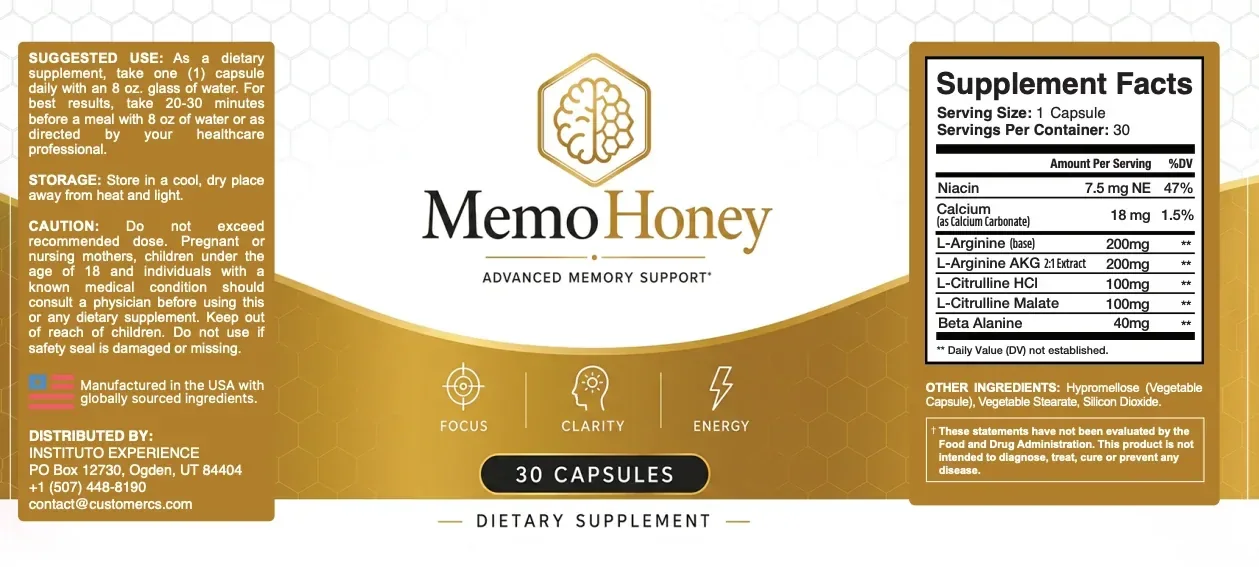
Memo Honey has 7.5 mg NE of niacin per capsule, listed as 47% of the Daily Value. NE means niacin equivalents. With an adult Daily Value of 16 mg NE and an adult upper intake from supplements of 35 mg a day, one capsule carries about a fifth of that ceiling.
It is the only row on the panel with a percentage, because it is the only vitamin. This post explains the unit, the numbers around it and the research on niacin and memory.
Of the seven rows on the MemoHoney panel, one reads like a nutrition label. That is not an accident: niacin is a vitamin, with a Daily Value and an upper limit.
- Niacin is vitamin B3; the body uses it to make NAD, a coenzyme in energy metabolism.
- NE (niacin equivalents) counts niacin and the niacin the body makes from tryptophan.
- 47% is 7.5 mg NE against the adult Daily Value of 16 mg NE.
- The adult upper intake from supplements is 35 mg a day; flushing is the reason.
- Add the niacin in every product you take, not just this one.
Why niacin is the row with a percentage
Look down the MemoHoney panel and one row stands out. Niacin, 7.5 mg NE, carries a percentage: 47. Calcium carries one too, 1.5. The five amino acids below them carry a mark instead, which the label explains as Daily Value not established.
The reason is simple. A percentage of the Daily Value can only be printed where a Daily Value exists, and Daily Values exist for vitamins and minerals. Niacin is vitamin B3. The body uses it to make NAD, the coenzyme that sits in the middle of energy metabolism in every cell, which is why the label’s word energy has a real anchor on this panel.
The NIH fact sheet on niacin describes it as a nutrient most people in the United States get enough of from food: meat, poultry, fish, whole grains, nuts and legumes all carry it. A supplement row of 7.5 mg is a nutrition-label amount, in the same range as the niacin in an ordinary meal.
What NE means
NE stands for niacin equivalents. The Institute of Medicine’s reference intakes define it because the body gets niacin two ways: directly from food and supplements, and by making it from tryptophan, an amino acid in protein. Sixty milligrams of tryptophan yields about one milligram of niacin, so a diet’s niacin is counted in equivalents that add the two together.
On a supplement panel, the NE figure is the niacin in the capsule, stated in the same unit the Daily Value uses. It is there so the percentage beside it can be calculated honestly: 7.5 mg NE against a Daily Value that is itself written in mg NE.
Forty-seven per cent of what
The adult Daily Value for niacin on a supplement label is 16 mg NE. Seven and a half divided by sixteen is 0.469, which the label rounds to 47%. The Daily Value is a single labelling figure; the recommended intakes behind it differ a little by sex, at 16 mg NE for adult men and 14 mg NE for adult women.
So one capsule provides a little under half of an adult’s daily niacin reference, and food provides the rest, usually with room to spare. That places the row where a vitamin in a daily formula normally sits: enough to count, not enough to change the arithmetic of a normal diet.
| Figure | Amount a day | What it is |
|---|---|---|
| MemoHoney, one capsule | 7.5 mg NE | The panel row: 47% of the Daily Value |
| Adult Daily Value | 16 mg NE | The figure the label’s 47% is computed against |
| Adult upper intake | 35 mg | The ceiling for niacin from supplements and fortified food |
| Share of the upper intake | about 21% | 7.5 mg against 35 mg |
| HPS2-THRIVE trial dose | 2,000 mg | Extended-release niacin as a cholesterol drug |
| Trial dose against the capsule | about 267 times | 2,000 mg against 7.5 mg |
Daily Value and upper intake from the Institute of Medicine reference intakes and the NIH niacin fact sheet; the trial dose from the HPS2-THRIVE safety analysis.
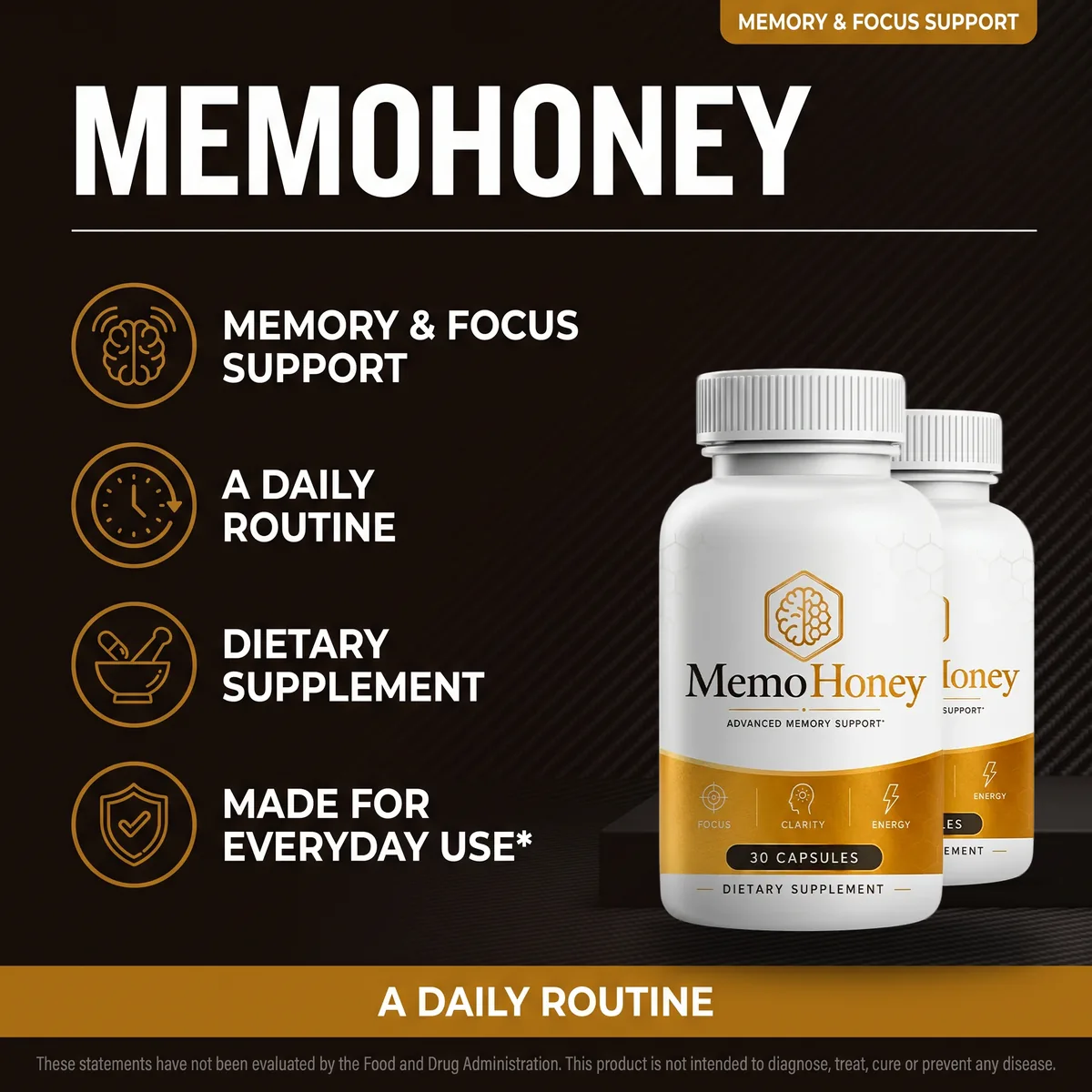
MemoHoney: 7.5 mg NE of niacin, one capsule a day
Seven printed rows, niacin at 47% of the Daily Value and well inside the upper intake. Packs of two, three or six bottles.
$79, $69 or $49 a bottle across two, three and six bottles, 60 days on every pack
Choose A MemoHoney PackOne capsule a day, 30 to a bottle. Lot MEM-26/GO-8806, shipped from the United States.
The upper intake: 35 mg a day
Niacin is one of the few vitamins with an upper limit that ordinary supplement users can reach. The reference intakes set the adult tolerable upper intake at 35 mg a day from supplements and fortified foods, and they name the effect it protects against: flushing, the warmth, redness and tingling of the skin that niacin causes at higher doses.
Against that ceiling, the MemoHoney row is about 21%. It leaves room, and the room is the point: the limit applies to all your supplements together. A multivitamin, an energy formula and a B-complex can each carry a niacin row of their own, and it is the total that counts.
That is the practical use of this row. It is the one number on the panel worth adding to the other labels in your cupboard.
Write down the niacin row from every product you take each day and add them together. If the total is near 35 mg, talk it over before adding another.
Flushing: why the ceiling sits at 35 mg
Flushing is the reason the upper intake is where it is. The reference intakes started from the lowest daily amount at which flushing was reported, 50 mg, and set the ceiling below it with a margin for safety. The result, 35 mg a day, is a limit for everyone, not a target.
A flush feels like a warm, red, sometimes itchy or tingling patch of skin, usually on the face and upper body, starting within an hour of a dose and fading on its own. It is uncomfortable rather than dangerous at those amounts, but it is a clear sign that the niacin total for the day has gone past what the body handles quietly.
At 7.5 mg NE, one capsule sits a long way below the 50 mg where the reference intakes place the first flushes. The row becomes relevant only when it is added to other niacin, which is why the arithmetic in the section above matters more than the row itself.
Where niacin sits in the formula
Niacin is the only vitamin on the MemoHoney panel. The five amino-acid rows below it are there for what they do in circulation and in muscle; the niacin row is there as a nutrient, at a nutrition-label amount, and its job in the body is well understood. It is converted to NAD and NADP, the two coenzymes that carry energy through hundreds of reactions in every cell, including the cells of the brain.
That gives the label’s word energy a plain, checkable meaning on this panel. It does not mean a stimulant, and there is none: no caffeine row, no botanical stimulant. It means a B vitamin the body needs every day, supplied at a little under half of the daily reference.
Niacin and memory: what the research looked at
The research that links niacin to memory is about diet, not capsules. The Chicago Health and Aging Project followed older adults and found that people who got more niacin from food had a lower risk of Alzheimer’s disease and slower cognitive decline. The CARDIA cohort tracked young adults for decades and linked higher niacin intake to better cognitive scores in midlife.
Both are observational studies. They show that people who eat more niacin tend to do better on these measures, which is consistent with niacin mattering and also with a diet rich in niacin being a better diet overall. Neither tested a supplement. What they support is modest and reasonable: niacin is a nutrient the brain relies on, and an adequate intake is worth having.
Where high-dose niacin went wrong
The picture changes completely at drug doses. Niacin was used for years as a cholesterol medicine at around 2,000 mg a day. The HPS2-THRIVE trial gave extended-release niacin with laropiprant to 25,673 patients and recorded serious adverse effects, including problems with blood sugar, infections and bleeding. A published case report describes liver injury in a person who took large amounts to try to pass a drug test.
Those doses are about 267 times the capsule’s row, and they are why the upper intake exists. They are also why the label’s first caution, do not exceed the recommended dose, matters for a formula with a vitamin in it.
Getting niacin from food
Because most niacin comes from food, the capsule row is best read as one contribution among several. The NIH fact sheet lists poultry, beef, pork and fish among the richest sources, with brown rice, nuts, seeds, legumes and fortified breads and cereals adding more. Protein brings tryptophan, which the body turns into niacin as well.
For most adults eating a varied diet, the daily reference is met before any supplement is counted. The 7.5 mg NE row adds a steady, known amount on top, and it is the known amount that makes it easy to keep the total in view.
Reading the niacin row on your own shelf
- Find the niacin row on every product you take, and note the amount per day.
- Add them together and compare the total with 35 mg.
- Take MemoHoney as the label says: one capsule, with 8 oz of water, 20 to 30 minutes before a meal.
- If you notice flushing, stop and look at the total niacin you are taking from all sources.
The full panel is on the Supplement Facts page, the label’s caution and the interactions worth knowing are on the side-effects page, and the three packs are compared on the pricing page.
Sources cited in this post
- Institute of Medicine (US), 1998: the niacin chapter of Dietary Reference Intakes for Thiamin, Riboflavin, Niacin, Vitamin B6, Folate, Vitamin B12, Pantothenic Acid, Biotin, and Choline, National Academies Press, NCBI Bookshelf NBK114304. This is where niacin equivalents (NE) are defined and where the adult ceiling of 35 mg a day from supplements comes from, set to avoid flushing. https://www.ncbi.nlm.nih.gov/books/NBK114304/
- Office of Dietary Supplements, National Institutes of Health: Niacin: Fact Sheet for Health Professionals, guidance read online. https://ods.od.nih.gov/factsheets/Niacin-HealthProfessional/
- Morris and colleagues (2004), Dietary niacin and the risk of incident Alzheimer's disease and of cognitive decline, in J Neurol Neurosurg Psychiatry 75(8):1093-9; PubMed 15258207. Niacin here came from diet, measured by questionnaire, and no capsule was given. https://pubmed.ncbi.nlm.nih.gov/15258207/
- Qin and colleagues (2017), Intake of niacin, folate, vitamin B-6, and vitamin B-12 through young adulthood and cognitive function in midlife: the Coronary Artery Risk Development in Young Adults (CARDIA) study, in Am J Clin Nutr 106(4):1032-1040; PubMed 28768650. https://pubmed.ncbi.nlm.nih.gov/28768650/
- Haynes and colleagues (2019), Serious Adverse Effects of Extended-release Niacin/Laropiprant: Results From the Heart Protection Study 2-Treatment of HDL to Reduce the Incidence of Vascular Events (HPS2-THRIVE) Trial, in Clin Ther 41(9):1767-1777; PubMed 31447131. It gave 2,000 mg of niacin with 40 mg of laropiprant daily to 25,673 patients. https://pubmed.ncbi.nlm.nih.gov/31447131/
- Durham and colleagues (2018), Hepatotoxicity upon using niacin to pass a drug test: A case report, in J Am Pharm Assoc (2003) 58(5):564-567; PubMed 29941333. https://pubmed.ncbi.nlm.nih.gov/29941333/