MemoHoney Official Website › Blog › Three to Six Weeks: Planning a Fair MemoHoney Trial
Planning the trialHow Long Does Memo Honey Take? A 60-Day Trial Plan, Week by Week
A fair Memo Honey trial fits inside the 60-day window from purchase. Write a three-line baseline before the first capsule, take one a day the same way each day, expect little in the first two weeks, and read your notes again at day 30 and before day 60.
Buyers on this desk most often describe 3–6 weeks before they notice a change. This post turns that wait into a plan.
The most common complaint on this desk is wanting more in week one. The most useful answer is a plan that does not ask week one to decide anything.

- Buyers here most often describe 3–6 weeks before noticing anything.
- The seller asks for 30 days of use before a claim; the window closes 60 days from purchase.
- A three-line baseline on day one makes the later reading possible.
- Change nothing else during the trial, or you cannot tell what did what.
- A home trial answers one question: do you want to keep going?
Three numbers that frame the trial
Three figures decide how a MemoHoney trial should run. The first is 3–6 weeks, the wait buyers on this desk most often describe before they notice a change. The second is 30 days, the use the seller asks for before a refund claim. The third is 60 days, the window for that claim, counted from the date of purchase rather than the day the parcel arrives.
Put together, they give a trial a natural shape. The first two weeks are for building the routine. Weeks three to six are where most buyers here start to form a view. Day 30 is a checkpoint, and the days before 60 are for deciding. Nothing about that plan is complicated, but writing it down before you start is what makes the result readable.
Before day one: write a baseline
A memory supplement is hard to judge from memory. By week five, the feeling of week zero has faded, and it is easy to decide either way on a single good or bad afternoon. The fix is three lines, written before the first capsule and kept somewhere you will find them.
Write how your focus holds up in a normal afternoon, how often you lose a word, a name or the reason you walked into a room, and how you have been sleeping. Keep the language plain and your own. The point is to have something to compare with, not to score yourself.
Note anything else that is changing. MedlinePlus lists sleep, stress, alcohol and medicine side effects among the everyday reasons memory varies. A new prescription, a house move or a run of bad nights will colour any trial, and it helps to know they were there.
Days 1 to 14: build the routine
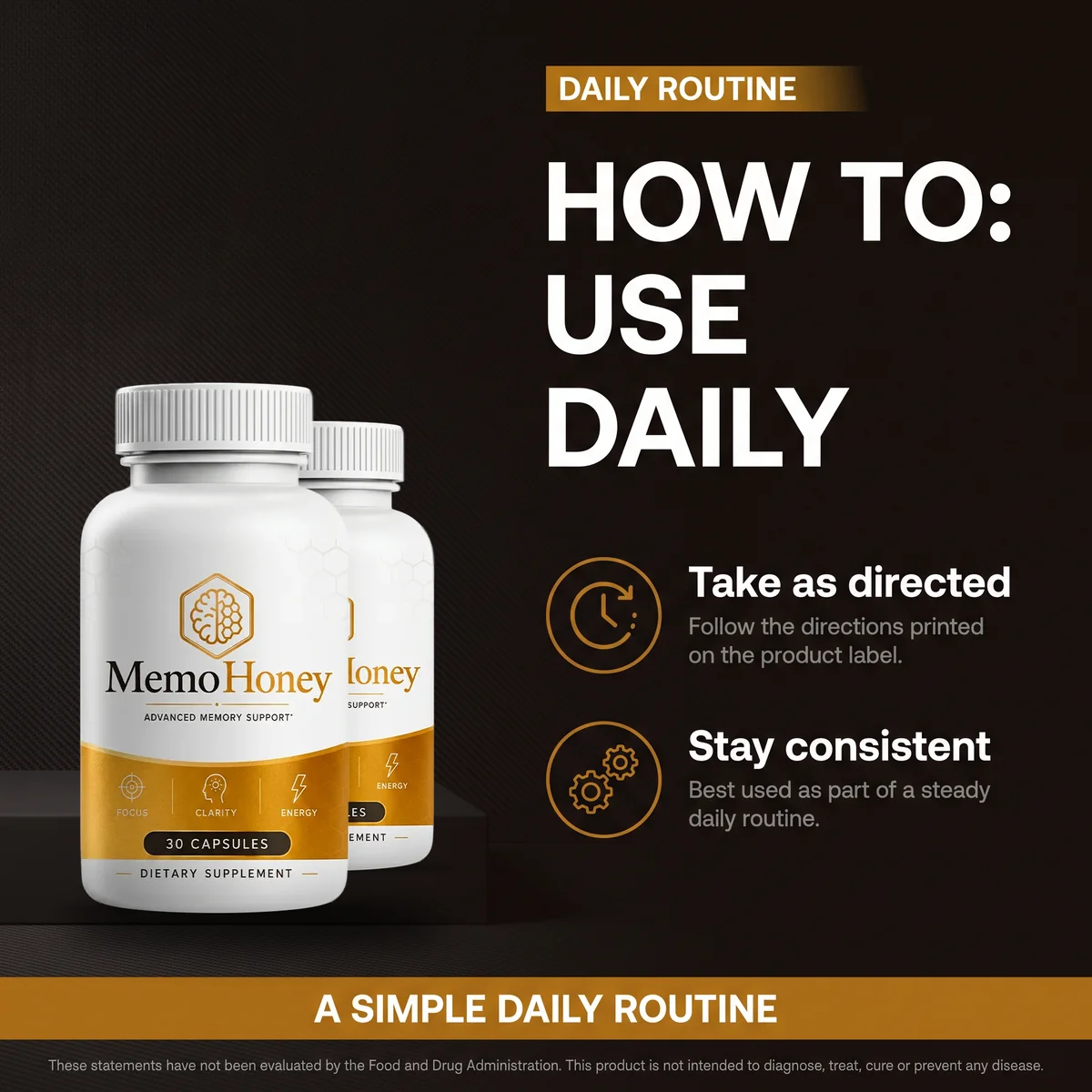
The label asks for one capsule a day with an 8 oz glass of water, 20 to 30 minutes before a meal, and the seller suggests the morning. The easiest way to keep that is to tie it to something you already do: the capsule goes next to the kettle, and the glass of water comes before breakfast.
These two weeks are for the habit, not the result. The reviews on this desk describe little in the first fortnight, and the complaint written most often is wanting more in week one. Expect that, and let the routine settle.

Start a fair MemoHoney trial
One capsule a day, a baseline on day one, and 60 days from purchase to decide. Two bottles cover the window exactly.
$79, $69 or $49 a bottle across two, three and six bottles, 60 days on every pack
Choose A MemoHoney PackOne capsule a day, 30 to a bottle. Lot MEM-26/GO-8806, shipped from the United States.
Weeks 3 to 6: the stretch that counts
This is where most buyers on this desk start to notice something, if they are going to. The rule for these weeks is to change nothing else. Keep the same capsule time, the same water, the same meal. If you start a new supplement, a new diet or a new sleep routine at the same moment, you will not be able to tell which one did what.
Keep a line or two each week against your baseline, in the same words. Some buyers notice sharper afternoons, some notice little, and some notice nothing at all. All three are useful results, because each tells you what to do at day 60.
What to write down each week
A weekly note takes two minutes if it follows the same shape every time. Use the three baseline lines, in the same words, and add two facts that make them readable later.
- Focus. How a normal afternoon held up this week, compared with day one.
- Lost words. Roughly how often a name, a word or a reason slipped away.
- Sleep. A rough average of hours a night, and whether it was broken.
- Missed capsules. How many days, if any, the routine slipped.
- Anything new. A new medicine, a stressful week, an illness, a holiday.
The last two lines are what turn impressions into something you can trust. A foggy week with four missed capsules and three bad nights says very little about the capsule. A clear week after a month of steady routine says more.
Five ways a trial goes wrong
Judging in week one
The complaint written most often on this desk. Week one is for the habit.
Changing two things
A new supplement or diet in the same month blurs the result.
Forgetting the date
The window is counted from purchase. Mark day 60 when you order.
An uneven routine
Capsules at random times, with or without water, make the weeks hard to compare.
No baseline
Without day-one notes, week five has nothing to be measured against.
Day 30 and day 60
Day 30 is the end of the first bottle and the point at which the seller’s condition for a claim is met. Reread your baseline and your weekly lines. If you bought two bottles, you are halfway through the window.
Day 60 is counted from the date of purchase, so mark it when you order. Before it arrives, decide. If you want to keep going, carry on. If you do not, call the order desk (number in the footer) with the order ID; the return goes tracked, at your cost, and the refund policy sets out the steps.
| When | Milestone | What to do |
|---|---|---|
| Before day 1 | Order placed; the 60 days start | Mark the purchase date; write a three-line baseline |
| Days 1–14 | The routine settles | One capsule, 8 oz of water, 20–30 minutes before a meal |
| Weeks 3–6 | Where most buyers here notice a change | Change nothing else; note what you notice |
| Day 30 | Bottle one ends; the seller’s 30-day condition is met | Reread the baseline |
| Days 30–60 | Bottle two; the deciding stretch | Keep the routine identical |
| Before day 60 | The window closes, counted from purchase | Keep going, or call the order desk (number in the footer) |
Timings from this desk’s review records and the seller’s refund terms. Results vary; some buyers notice nothing.
What a home trial can and cannot show
A home trial is not a clinical trial, and it is worth being clear about the difference. COSMOS-Mind gave over two thousand older adults a daily multivitamin or a placebo for three years and tested their memory the same way every year; the clinic sub-cohort did it in person. Only that kind of design can separate a supplement from expectation, sleep and a quieter month.
A home trial answers a smaller and more personal question: after two months of the routine, do you want to keep it? That is a fair question to ask of any supplement, and NCCIH’s advice on using supplements wisely encourages exactly this kind of attention. It also sets expectations correctly: NCCIH’s evidence digest finds no supplement proven to prevent cognitive decline, so the trial is about how you feel day to day, not about the long term.
Why the morning works best
The label asks for the capsule 20 to 30 minutes before a meal, and the seller suggests the morning. Before breakfast satisfies both, and it has a practical advantage for a trial: mornings are the most regular part of most days. Evenings move around with work, dinners out and late nights; the first glass of water of the day does not.
Pick a fixed anchor and keep it for the whole sixty days: the capsule beside the kettle, the coffee machine or the toothbrush. A routine that hangs on something you already do every morning survives weekends and travel far better than one that relies on remembering.
If you notice nothing
Some buyers notice nothing, and a plan should allow for that result as calmly as any other. If your weekly lines at day 45 read the same as your baseline, and the routine has been steady, that is a clear answer for you. Buyers on this desk describe 3–6 weeks as the usual wait, so by then the routine has had its fair run.
The 60-day window exists for exactly this case. Call the order desk (number in the footer) with the order ID before day 60, post the return tracked to the New York returns address, and the refund follows the timings on the guarantee page. No one needs a reason beyond “it was not for me”.
Which pack fits a fair trial
Two bottles hold sixty capsules, which covers the window exactly. Three bottles hold ninety, which runs a month past it and is the first pack to ship free. Six bottles hold 180, the pack most buyers on this desk choose, at the lowest price a bottle. The pricing page sets them side by side, and every pack carries the same 60-day window.

Sources cited in this post
- Baker and colleagues (2023), Effects of cocoa extract and a multivitamin on cognitive function: A randomized clinical trial, in Alzheimers Dement 19(4):1308-1319; PubMed 36102337. Participants took 500 mg of cocoa flavanols a day, a standard multivitamin, or both, for three years. https://pubmed.ncbi.nlm.nih.gov/36102337/
- Vyas and colleagues (2024), Effect of multivitamin-mineral supplementation versus placebo on cognitive function: results from the clinic subcohort of the COcoa Supplement and Multivitamin Outcomes Study (COSMOS) randomized clinical trial and meta-analysis of 3 cognitive studies within COSMOS, in Am J Clin Nutr 119(3):692-701; PubMed 38244989. https://pubmed.ncbi.nlm.nih.gov/38244989/
- National Center for Complementary and Integrative Health, National Institutes of Health: Dietary Supplements and Cognitive Function, Dementia, and Alzheimer's Disease: What the Science Says, guidance read online. https://www.nccih.nih.gov/health/providers/digest/dietary-supplements-and-cognitive-function-dementia-and-alzheimers-disease-science
- MedlinePlus topic page Memory, from the National Library of Medicine at NIH in Bethesda, read online. https://medlineplus.gov/memory.html
- National Center for Complementary and Integrative Health, National Institutes of Health: Using Dietary Supplements Wisely, guidance read online. https://www.nccih.nih.gov/health/using-dietary-supplements-wisely