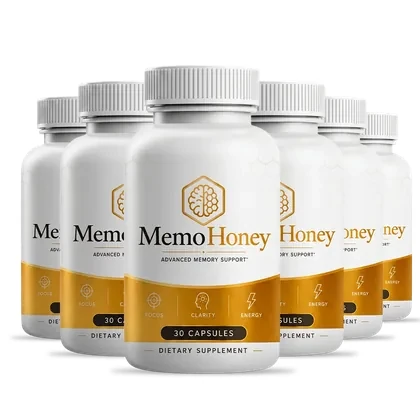
MemoHoney Official Website › Blog › Two Arginine and Citrulline Forms on the MemoHoney Label
Ingredient formsTwo Arginine and Citrulline Forms: Reading the MemoHoney Label
MemoHoney prints four related amino-acid rows: L-arginine, arginine AKG, L-citrulline HCl and L-citrulline malate. Each has a separate amount per capsule.
The four names show the forms in the capsule. They do not show that the finished product was tested, or let a reader turn milligrams on the label into a promised result.
Four similar ingredient names can look like duplicate claims. The label is more useful when read as four separately weighed forms, then compared carefully with the cited evidence.
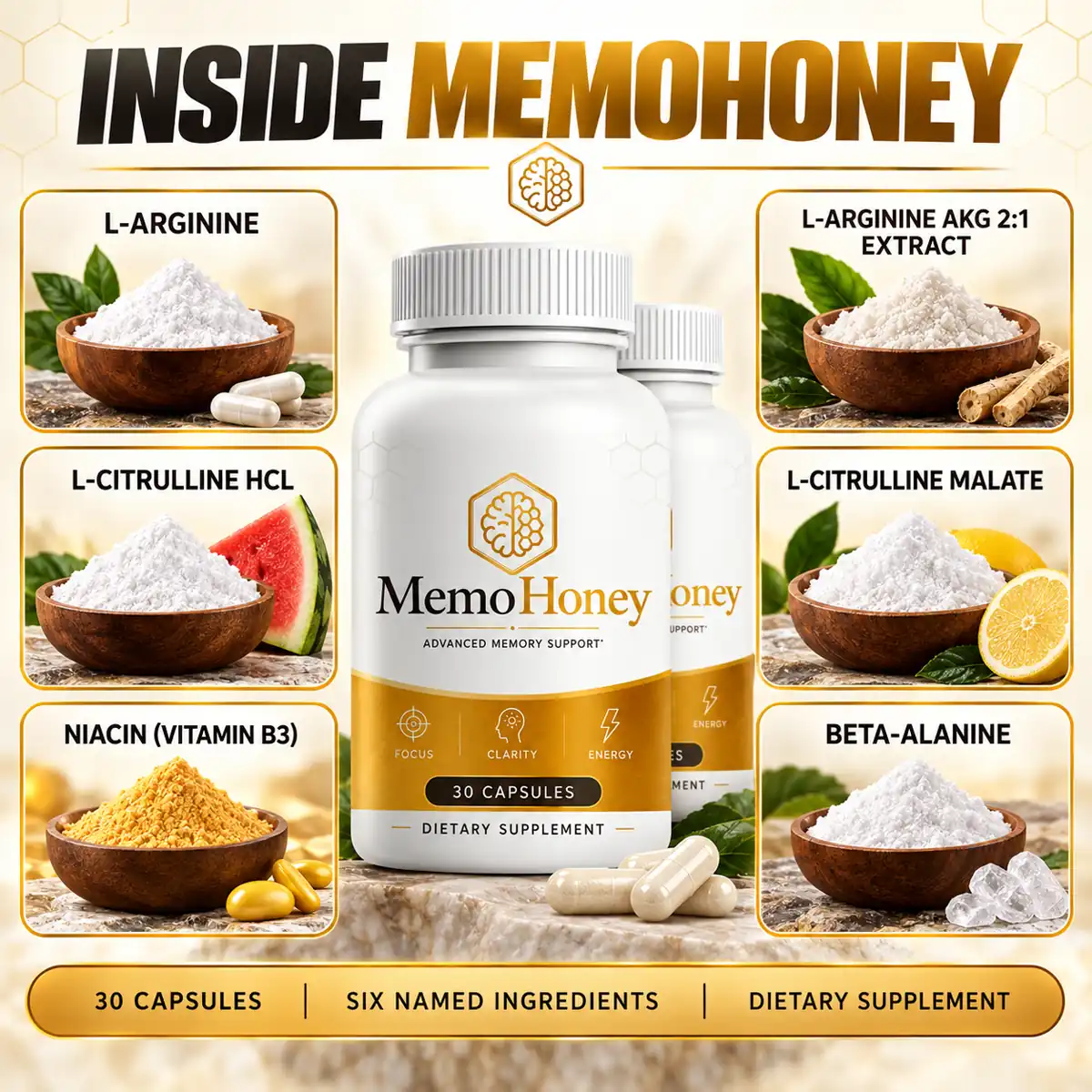
- The panel lists four separate arginine and citrulline forms, totaling 600 mg as printed.
- An attached compound changes a row's name and total weight; it is not automatically extra amino acid.
- Published studies use their own form, daily dose, duration and population.
- No cited study tests the seven-row MemoHoney capsule at its label amounts.
- The label caution still matters when a formula includes ingredients related to blood flow.
Four names on one label
MemoHoney's Supplement Facts panel does not use a single umbrella phrase such as an amino-acid blend. It gives four separate rows: L-arginine, 200 mg; L-arginine AKG 2:1 extract, 200 mg; L-citrulline HCl, 100 mg; and L-citrulline malate, 100 mg. Added exactly as printed, those rows total 600 mg. That total describes the label weights of the four forms. It is not a claim that each row delivers the same amount of one underlying compound after the attached material is accounted for.
The first distinction is between a free amino acid and a named form. L-arginine is listed as the base amino acid. Arginine AKG identifies arginine combined with alpha-ketoglutarate. L-citrulline HCl identifies citrulline in a hydrochloride form, while L-citrulline malate identifies citrulline combined with malic acid. The label gives the complete form name so a reader can see what was weighed.
That is the useful claim the panel makes. It tells a buyer that there are two arginine rows and two citrulline rows, rather than one vague proprietary mixture. The label does not disclose a conversion calculation, an absorption result or a clinical result for the finished capsule. Those are different questions and need different evidence.
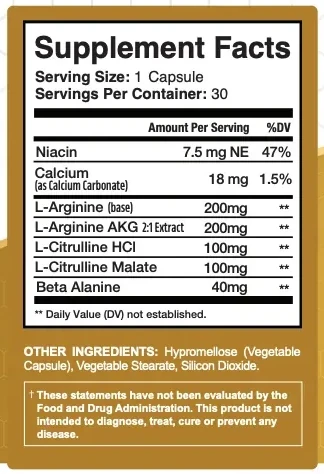
Why form names matter
A form name is not decoration. It helps identify what was used in a study and what was used in a product. For example, a trial of oral L-citrulline cannot simply be treated as a trial of every citrulline salt or combination at every dose. The same care applies to arginine and arginine AKG. A label reader can begin by matching the form name, then looking at the amount, frequency, study length and population before drawing any comparison.
The oral arginine and citrulline pharmacokinetic study cited on this site is useful for explaining why the names are related: it measured how oral arginine and citrulline affected circulating arginine at the doses used in that study. It is not a MemoHoney trial, and its dosing protocol is not the MemoHoney label. The right reading is narrower: the paper gives context for two named amino acids, while the bottle tells you which forms and quantities are in one capsule.
Form names also prevent double counting. A 200 mg AKG row is not 200 mg of free arginine plus 200 mg of a separate free ingredient. The label names the compound as a compound. Treating each printed row honestly is more useful than trying to inflate the total into a number the panel does not state.
What the published dose context looks like
The dose comparison should start with the label: 200 mg of L-arginine and 200 mg of arginine AKG, then 100 mg of citrulline HCl and 100 mg of citrulline malate. Those are per-capsule values. The published literature quoted on the information pages uses different daily doses, sometimes measured in grams, and different preparations. A label amount is a fact about the capsule; a study dose is a fact about that study.
For arginine AKG, the pharmacokinetic and performance paper used grams per day in trained adult men. Its form, schedule and participants are part of the result. It cannot be cut down to a slogan that a 200 mg label row will do the same thing. For citrulline, the {L('cit_bp', 'systematic review')} includes interventions in gram-scale daily doses; again, the study context cannot be swapped for the label's 100 mg row.
The citrulline malate literature is similarly specific. The older-adult pilot trial has its own daily amount, duration and exercise setting. Those differences are not flaws in the label; they are exactly why a fair product page should show both numbers instead of silently treating a related ingredient study as a test of this capsule.
| What the label says | What a study comparison must also state |
|---|---|
| L-arginine 200 mg; arginine AKG 200 mg | The specific arginine form, daily dose, participants and duration |
| Citrulline HCl 100 mg; citrulline malate 100 mg | The citrulline form, daily dose, setting and measured outcome |
| One capsule as the serving | Whether the research used one dose or multiple daily doses |
| No Daily Value set for the four rows | A study's evidence is not supplied by a Daily Value percentage |
The left column is transcribed from the MemoHoney panel. The right column lists the questions a cited paper must answer before it can be compared fairly.
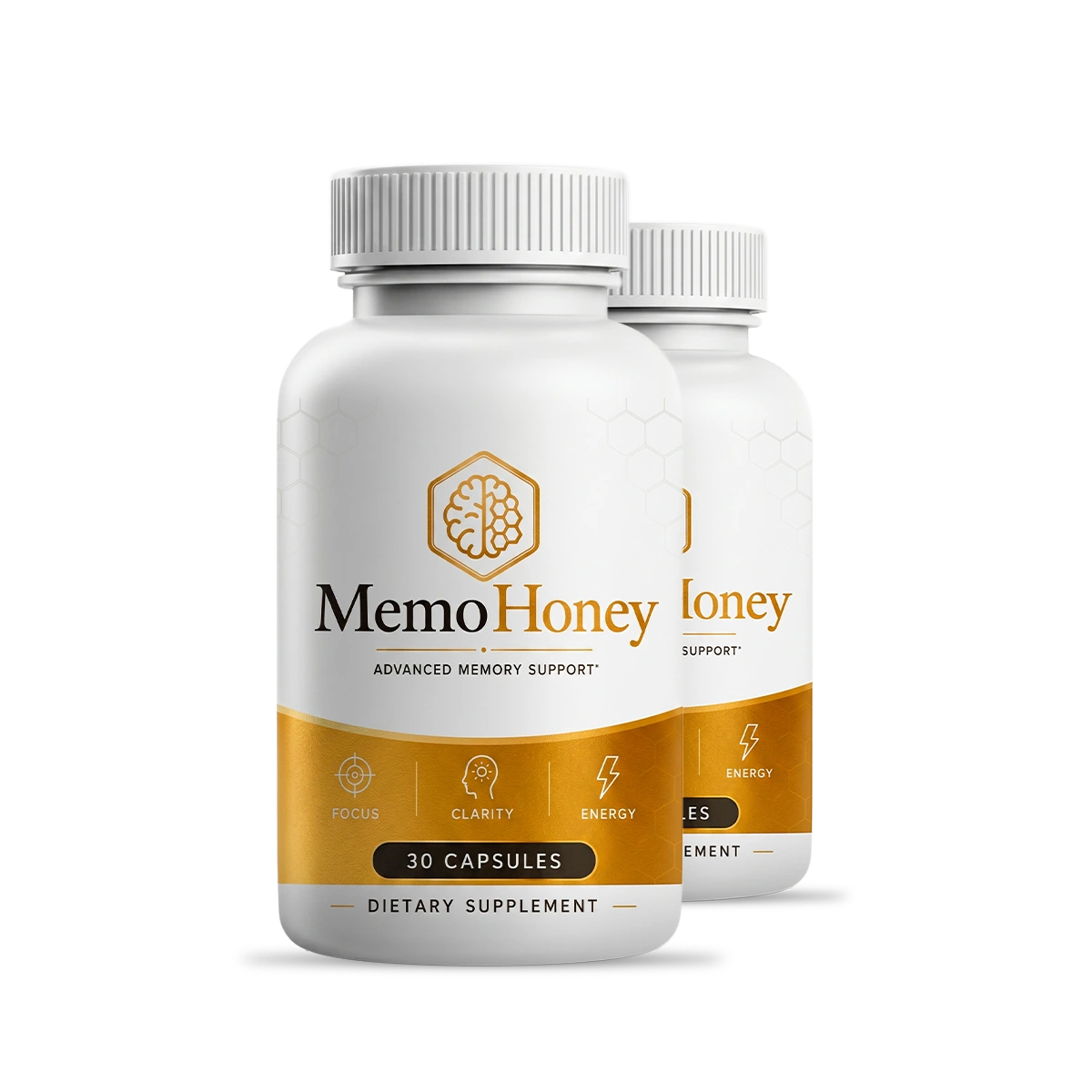
Read the MemoHoney panel before choosing a pack
The label names all four amino-acid forms and their amounts. Use the full panel and caution to decide whether the product is appropriate for you.
The label gives form names and amounts; it does not replace medical advice., 60 days on every pack
Choose A MemoHoney PackOne capsule a day, 30 to a bottle. Lot MEM-26/GO-8806, shipped from the United States.
What the four rows do not establish
Four related names on a label do not prove that the combination is better than one form, that the rows work together at the listed amount or that a person will notice a particular effect. The MemoHoney label calls the product Advanced Memory Support and carries focus, clarity and energy wording on its front. Those are label claims. The panel's job is different: it lets a reader check the ingredients and amounts behind the presentation.
The same restraint applies to a total. Six hundred milligrams across four forms is not a research dose until a specific study uses that exact combination and schedule. It is also not a safety conclusion. Reading a complete label is a better starting point than reading only an advert, but it does not replace personal medical advice or a clinician's assessment of medicines, conditions and other supplements.
The website's dosage table therefore keeps a simple rule: it identifies the label amount, identifies the published study amount and says directly that no cited paper tested the finished MemoHoney capsule. That protects the difference between ingredient context and product evidence.
A fair way to compare a label with a paper
Begin by copying the label exactly: the name of the row, its form and the amount per serving. Next, read the methods of the paper instead of relying only on an abstract headline. The questions are practical: was the same form used, what amount was given each day, how long did the study run, who took part and what was actually measured? A good comparison leaves those differences visible. It does not turn a broad statement about nitric-oxide biology into a promise about this capsule.
This approach is especially useful where names are similar. Arginine, arginine AKG, citrulline HCl and citrulline malate share part of a name, but the full form is part of the label fact. A study of one cannot silently become evidence for all four. The MemoHoney panel helps by spelling out every form. The research references help by showing the source behind a narrow statement. The two should be read side by side, not merged into a simplified claim.
The final comparison is between the paper and the finished product. No source on this site reports a trial of the seven-row MemoHoney capsule. That fact should stay visible at the end of any label discussion. It does not make the label unhelpful; it explains why a label-first review can be transparent about ingredients without claiming a result the product has not been shown to deliver.
- 1
Match the form
Free amino acids, salts and combined forms should be named rather than collapsed into one word.
- 2
Match the dose
A per-capsule milligram figure is not automatically the study's daily protocol.
- 3
Match the evidence
Only a study of the finished formula can establish results for the finished formula.
Read the directions and caution with the ingredients
The ingredient table is not the entire label. MemoHoney directs adults to take one capsule daily with an 8 oz glass of water, 20 to 30 minutes before a meal. It tells users not to exceed the recommended dose, to keep the bottle out of reach of children and not to use it if the seal is damaged or missing. Those instructions limit what can be inferred from a list of amino acids.
The NCCIH guide to using dietary supplements wisely advises readers to discuss supplement use with a health professional, particularly when taking medicines. MemoHoney's own caution asks people who are pregnant or nursing, under 18 or who have a known medical condition to consult a physician before use. For anyone using medicine that affects blood pressure or circulation, the full label is the appropriate thing to take to a prescriber rather than an isolated ingredient name taken from an article.
A good label-first routine is deliberately unglamorous: match the bottle to the panel, follow the stated serving, keep a record of other supplements and medicines, and stop if a clinician says the combination is unsuitable. That is more defensible than trying to recreate a research protocol from four labels rows.
The practical takeaway
MemoHoney prints two arginine and two citrulline forms rather than hiding them in one blend. The panel confirms the names and per-capsule amounts: 200 mg, 200 mg, 100 mg and 100 mg. It does not promise that the forms are interchangeable, that their weights convert one-for-one to a free amino acid or that the finished product has been tested in the way a cited ingredient study was tested.
For a reader, that is still useful information. It makes it possible to compare a bottle with a study carefully instead of pretending the comparison is automatic. Read the panel first, use the source list for the narrow question each paper answers, and keep the directions and caution with the ingredient list.
Sources cited in this post
- Schwedhelm E, Maas R, Freese R, et al. Pharmacokinetic and pharmacodynamic properties of oral L-citrulline and L-arginine: impact on nitric oxide metabolism. Br J Clin Pharmacol. 2008;65(1):51-9. Citrulline 3 g twice daily raised trough plasma arginine furthest. PMID 17662090. https://pubmed.ncbi.nlm.nih.gov/17662090/
- Campbell B, Roberts M, Kerksick C, et al. Pharmacokinetics, safety, and effects on exercise performance of L-arginine alpha-ketoglutarate in trained adult men. Nutrition. 2006;22(9):872-81. Four grams three times daily, 12 g/day for eight weeks. PMID 16928472. https://pubmed.ncbi.nlm.nih.gov/16928472/
- Barkhidarian B, Khorshidi M, Shab-Bidar S, et al. Effects of L-citrulline supplementation on blood pressure: A systematic review and meta-analysis. Avicenna J Phytomed. 2019;9(1):10-20. Doses ran 3 to 9 g/day, and only the arms at 6 g/day or more moved diastolic pressure. PMID 30788274. https://pubmed.ncbi.nlm.nih.gov/30788274/
- Ramos-Hernández R, Pascual-Fernández J, Alvarez-Pardo S, et al. Short-term citrulline malate supplementation enhances lower-limb function in physically active older women: A pilot randomized controlled trial. Clin Nutr ESPEN. 2026;74:103356. Twenty women aged 60-75, 3 g/day for six weeks alongside exercise. PMID 42162613. https://pubmed.ncbi.nlm.nih.gov/42162613/
- Using Dietary Supplements Wisely. National Center for Complementary and Integrative Health, National Institutes of Health. https://www.nccih.nih.gov/health/using-dietary-supplements-wisely