MemoHoney Official Website › Blog › MemoHoney Label: What No Daily Value Means
Reading the labelWhat “No Daily Value Set” Means on the MemoHoney Label
Five MemoHoney rows have a number in milligrams but no percentage in the Daily Value column. The label's footnote says Daily Value not established.
That phrase does not mean an ingredient is absent, proven, unsafe or automatically useful. It tells the reader that the panel has no Daily Value reference number for that row.
A percentage on a Supplement Facts panel is easy to over-read. This guide separates what the MemoHoney label confirms from what a missing Daily Value cannot answer.
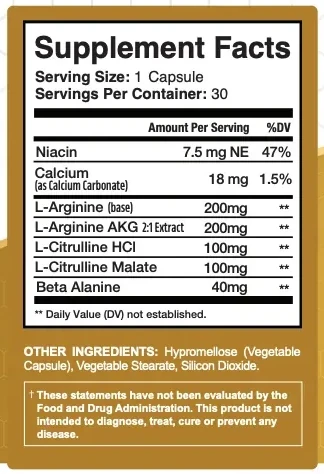
- The MemoHoney panel has seven rows; niacin and calcium carry a Daily Value percentage.
- The other five rows still state an amount per capsule: 40 to 200 mg.
- No Daily Value set is a reference-gap, not a performance, safety or quality grade.
- A panel can tell you what is in a serving; it cannot prove a finished product was tested.
- The label's directions and caution remain part of the reading, not fine print.
Start with the column heading
A Supplement Facts panel does two separate jobs. It identifies a serving, then lists the ingredients and amounts in that serving. When a nutrient has a Daily Value, the right-hand column can also show how much of that reference value the serving provides. A reader should not treat those jobs as interchangeable. The amount column answers what is printed in one capsule. The percentage column is a comparison only where a Daily Value exists.
MemoHoney makes the distinction visible. The label gives one capsule as the serving and thirty servings per container. Its first two rows are niacin, 7.5 mg NE, and calcium, 18 mg. The panel prints percentages for both. Below a divider, it lists two arginine forms, two citrulline forms and beta-alanine. Each has a milligram amount, but the percentage column is replaced by the footnote mark.
Reading from left to right keeps the order clear: name, amount, then Daily Value where one is established. The phrase in the final column does not erase the amount printed in the middle column. It only says that the panel has no official Daily Value number to use as a denominator for that ingredient.
Why niacin and calcium have percentages
Niacin's 7.5 mg NE is printed as 47% of the Daily Value. Niacin equivalents, or NE, are the unit used in the reference intake for niacin. The adult Daily Value is 16 mg NE, so the percentage comes from comparing the label's number with that public reference. The same source discusses upper intake levels for supplemental niacin; that is a separate safety context, not a claim that this product prevents or treats anything.
Calcium is treated the same way. The panel names calcium carbonate and gives 18 mg, or 1.5%. The NIH calcium fact sheet gives the reference amount behind that percentage. A percentage is therefore useful as a label-reading aid: it lets a person see the scale of a nutrient relative to an established daily reference. It does not compare every ingredient on the panel with every other ingredient.
The label's first two rows have this feature because the Daily Value system has a number for those nutrients. The rows below use a different form of disclosure: the product must still state the ingredient and its per-serving amount, but it does not print a made-up percentage.
Forty-seven per cent is not a claim that niacin is the product's most important ingredient. It is simply the largest printed Daily Value percentage on this particular panel.
What the five MemoHoney rows actually say
The five rows without a Daily Value are not hidden in a blend. The label names and weighs each one: L-arginine, 200 mg; L-arginine AKG 2:1 extract, 200 mg; L-citrulline HCl, 100 mg; L-citrulline malate, 100 mg; and beta-alanine, 40 mg. Together the forms add to 640 mg as printed. Because AKG, hydrochloride and malate are attached forms, their row weight is not necessarily the same as the weight of the underlying amino acid. The label is precise about the form; it is not a recipe for converting one form into another.
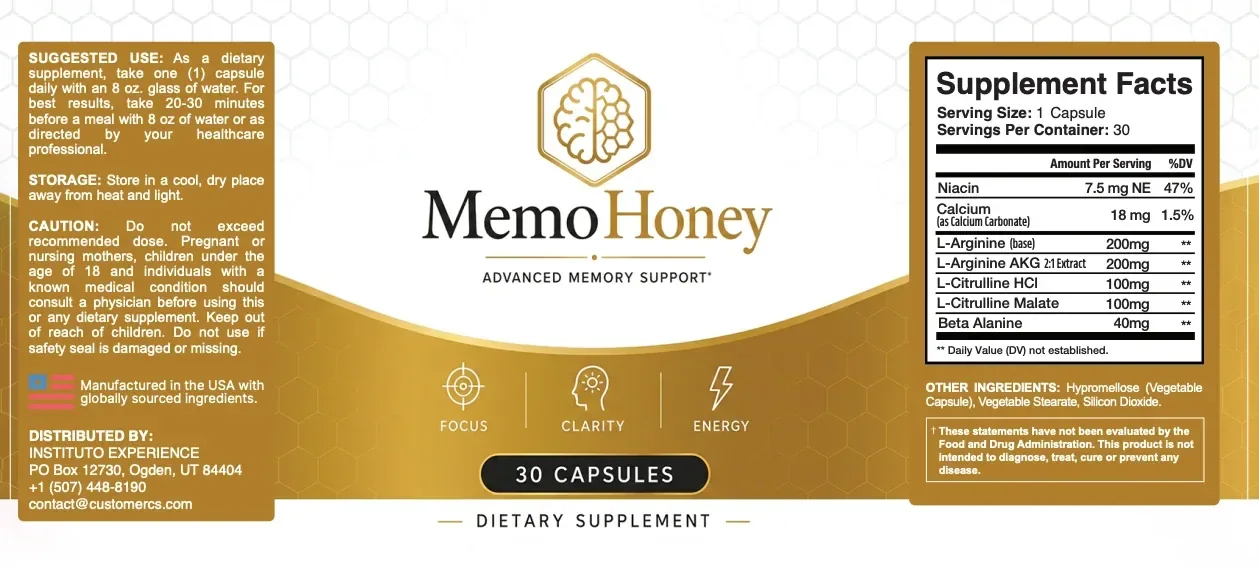
This is why a complete panel is more useful than a front-label ingredient list. The front artwork names six headline ingredients. The panel shows their forms, puts an amount beside each and adds calcium as a seventh row. It also identifies the other ingredients outside the panel: the hypromellose capsule shell, vegetable stearate and silicon dioxide. Those details give a buyer a document to compare against the bottle that arrives.
For a compact check, use the table below. It is a transcription of the panel, not an estimate and not a promise about outcomes.
| Panel row | Per capsule | % Daily Value | Type | Advertised? |
|---|---|---|---|---|
| Niacin | 7.5 mg NE | 47% | Vitamin | Yes |
| Calcium (as calcium carbonate) | 18 mg | 1.5% | Mineral | No |
| L-Arginine (base) | 200 mg | No Daily Value set | Amino acid | Yes |
| L-Arginine AKG (2:1 extract) | 200 mg | No Daily Value set | Amino acid | Yes |
| L-Citrulline HCl | 100 mg | No Daily Value set | Amino acid | Yes |
| L-Citrulline Malate | 100 mg | No Daily Value set | Amino acid | Yes |
| Beta Alanine | 40 mg | No Daily Value set | Amino acid | Yes |
Read off the MemoHoney Supplement Facts panel, in the label’s own row order. Serving size one capsule; thirty servings per container.
Read the MemoHoney label before choosing a pack
The printed panel names seven rows and gives every amount. Use the full label, directions and caution to decide whether the product is appropriate for you.
Label facts first, then purchase terms., 60 days on every pack
Choose A MemoHoney PackOne capsule a day, 30 to a bottle. Lot MEM-26/GO-8806, shipped from the United States.
What no Daily Value set cannot tell you
It is tempting to fill a blank percentage with a conclusion. The label does not support that. No Daily Value set does not mean zero. It does not establish that an ingredient works for memory, focus or any medical condition. It does not say the ingredient is unsuitable, and it does not rank it below the nutrient rows. It only means the panel has no Daily Value benchmark for the ingredient.
Research papers use other kinds of comparisons, such as a dose, a population, a study length and an outcome. Those details cannot be replaced by a Daily Value. The MemoHoney ingredients page and its dosage table put the printed amounts beside the amounts used in cited research. The comparison is deliberately not a claim that the finished capsule was studied: no source cited on this site tests the seven-row product as a whole.
That separation matters for fair reading. The bottle can support a statement about what it contains at one serving. A cited study can describe a different product, amount or population. Neither turns a percentage blank into evidence of a result.
Three questions a blank percentage should not make you guess
The first question is whether the label names the form and amount. On this panel, it does: each of the five rows has both. A reader does not need to guess whether there is a meaningful amount hidden inside a blend, because the panel supplies the per-capsule figure. That is a useful disclosure even though the Daily Value column has no percentage. The next question is whether the number is being compared with the right reference. A nutrient Daily Value and a research dose are different kinds of reference and should not be substituted for one another.
The second question is whether an ingredient paper actually studies the same thing. A paper may use a free form, a salt, a larger daily dose, a powder or a study period that differs from one capsule per day. That does not make the paper irrelevant, but it sets a limit on the conclusion. It can provide background on the named ingredient; it cannot verify the complete MemoHoney formula unless the formula itself was the intervention. This page does not claim such a study exists.
The third question is personal rather than numerical. A label cannot know a reader's medical history, medicines, allergy concerns or other products used that day. The panel, directions and caution are the facts to bring to a qualified professional. A missing Daily Value percentage is never a reason to compensate by taking more than the label says. One capsule is the printed serving, and the bottle's caution remains the governing instruction for the product.
- 1
Read the amount
An amount per capsule is a label fact. Preserve the form name when writing it down.
- 2
Name the comparison
Ask whether the number is being compared with a Daily Value, a study dose or nothing at all.
- 3
Keep the caution with the panel
Directions and safety wording are part of the product information, not an optional footer.
A label-first checklist before choosing a supplement
First, identify the serving size. For MemoHoney it is one capsule, so the seven amounts are already daily amounts if the directions are followed. Second, identify whether each named ingredient has an amount. This panel does. Third, distinguish a Daily Value percentage from an ingredient amount. Fourth, read the directions, other ingredients and caution before treating the formula as a fit for you.
The Office of Dietary Supplements consumer guide recommends checking labels and talking with a health professional about supplements, especially when medicines or health conditions are involved. The MemoHoney label specifically asks pregnant or nursing people, people under 18 and people with a known medical condition to consult a physician before use. It also says not to exceed the stated dose and not to use a bottle with a damaged or missing safety seal.
The final question is the simplest: can the bottle in hand be matched to the panel on the page? If a row, amount, directions line or caution does not match, pause rather than assuming the difference is harmless. A Supplement Facts panel is a decision aid, not a substitute for personal medical advice.
The plain-English takeaway
MemoHoney's five amino-acid rows have printed amounts but no Daily Value percentage because the Daily Value system does not set a reference for those rows. That is not missing disclosure: the milligram figures are present. It is also not a shortcut to a performance conclusion. Read the amounts, the form names, the directions and the caution together, then use the cited research pages only for the questions they can actually answer.
For this product, the label provides the strongest starting point: one capsule a day, thirty per bottle, seven named rows and three other ingredients. The rest of the decision belongs to the reader's needs and, when relevant, a clinician who can consider medicines and medical history.
Sources cited in this post
- Institute of Medicine (US) Standing Committee on the Scientific Evaluation of Dietary Reference Intakes. Niacin. In: Dietary Reference Intakes for Thiamin, Riboflavin, Niacin, Vitamin B6, Folate, Vitamin B12, Pantothenic Acid, Biotin, and Choline. Washington (DC): National Academies Press; 1998. Defines niacin equivalents (NE) and sets the adult tolerable upper intake at 35 mg/day from supplements, with flushing as the critical effect. NCBI Bookshelf NBK114304. https://www.ncbi.nlm.nih.gov/books/NBK114304/
- Niacin: Fact Sheet for Health Professionals. Office of Dietary Supplements, National Institutes of Health. https://ods.od.nih.gov/factsheets/Niacin-HealthProfessional/
- Calcium: Fact Sheet for Health Professionals. Office of Dietary Supplements, National Institutes of Health. https://ods.od.nih.gov/factsheets/Calcium-HealthProfessional/
- Dietary Supplements: What You Need to Know. Office of Dietary Supplements, National Institutes of Health. https://ods.od.nih.gov/factsheets/WYNTK-Consumer/
- Questions and Answers on Dietary Supplements. U.S. Food and Drug Administration. https://www.fda.gov/food/information-consumers-using-dietary-supplements/questions-and-answers-dietary-supplements